Journal Category: Study

  • Biennale de Lyon 2024: Les voix des fleuves — Chapter 1 | Musée d’art contemporain de Lyon

    Biennale de Lyon 2024: Les voix des fleuves — Chapter 1 | Musée d’art contemporain de Lyon

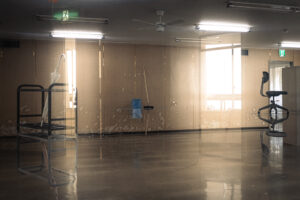
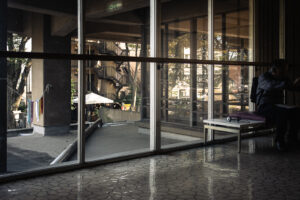
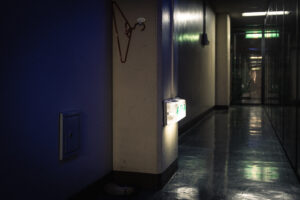
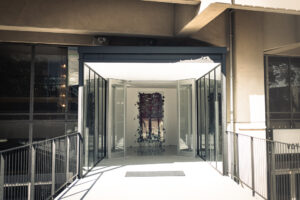
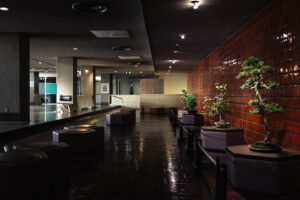
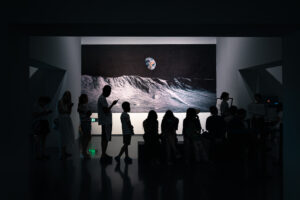
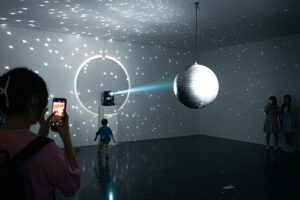
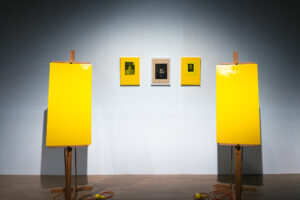
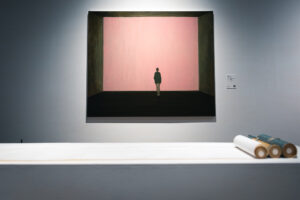
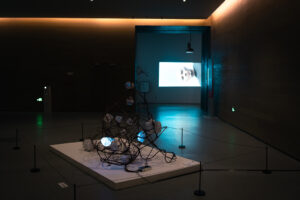
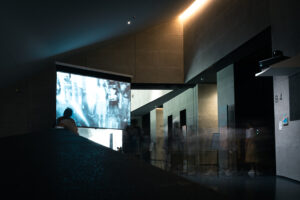
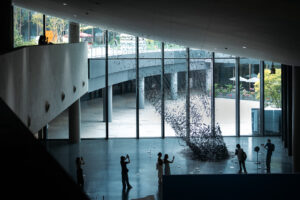
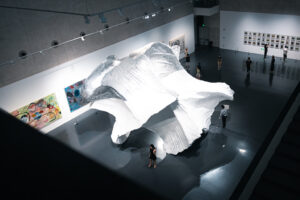
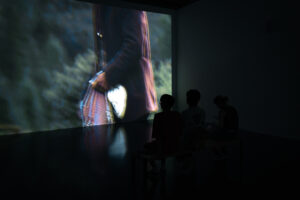
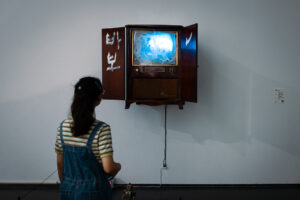
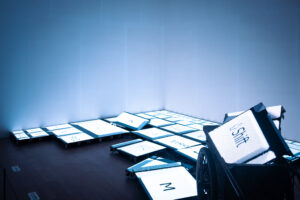
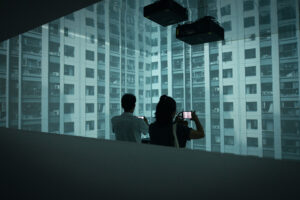
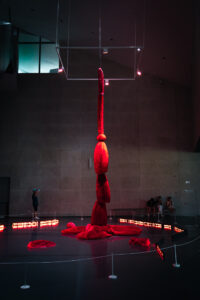
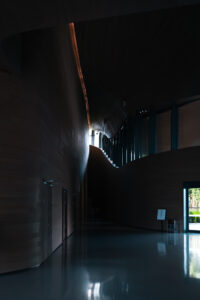
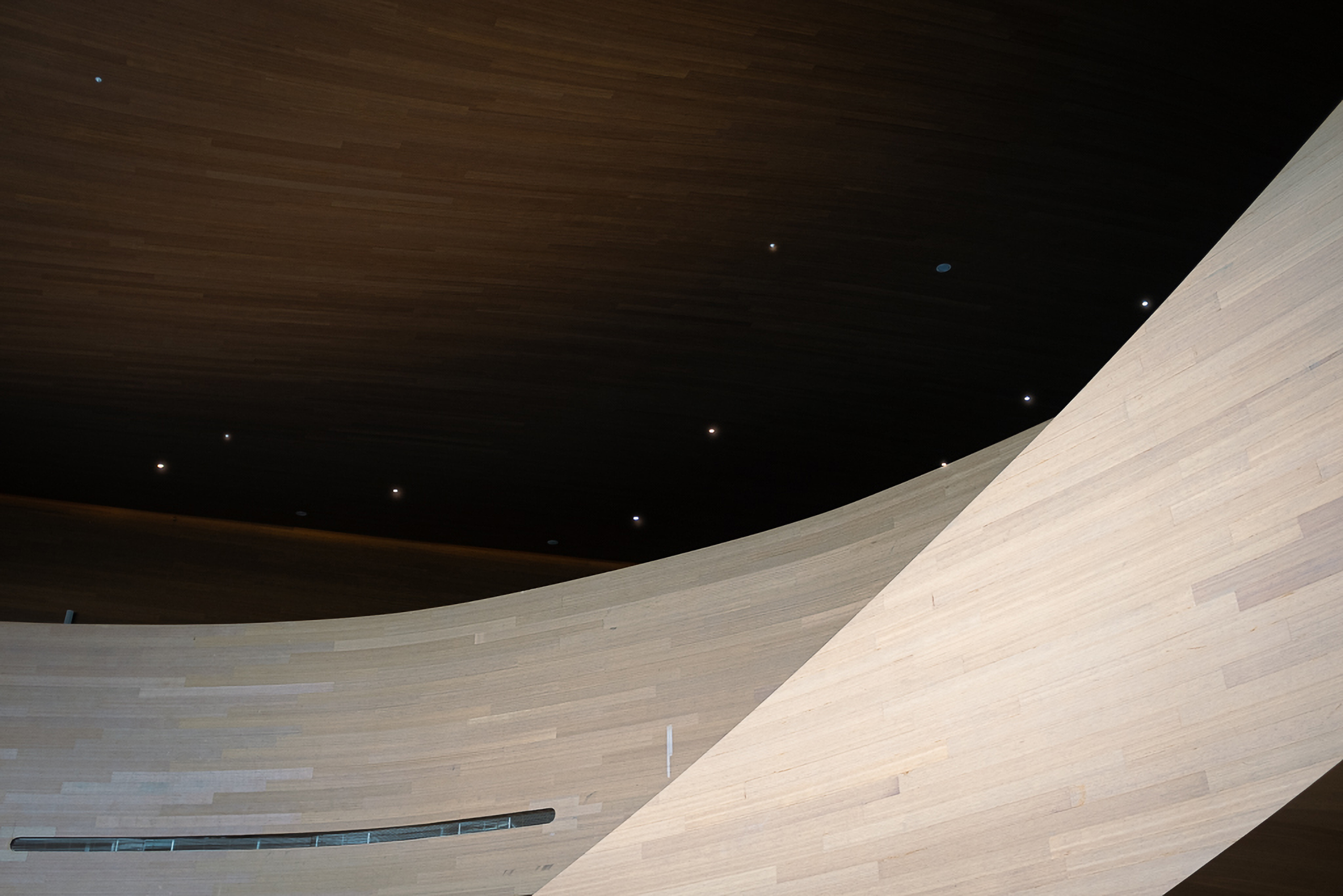
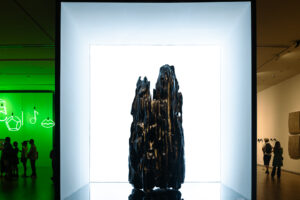
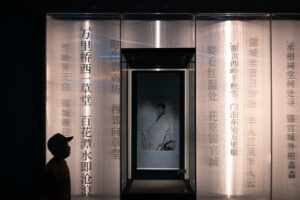
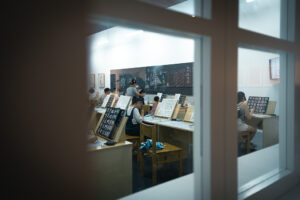
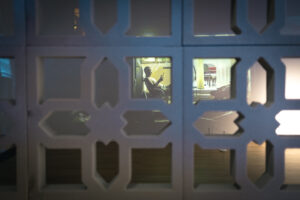
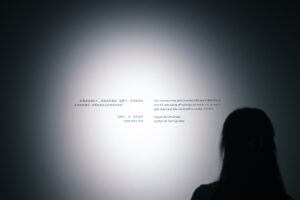
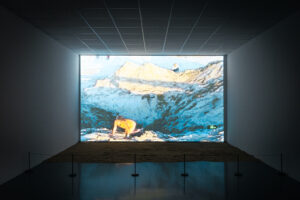
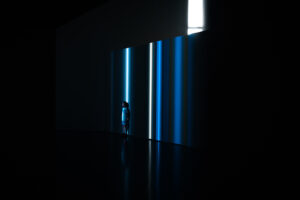
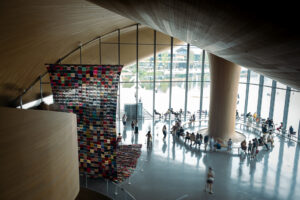
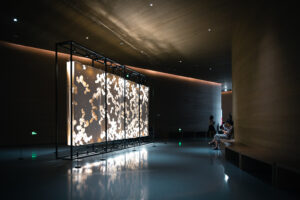
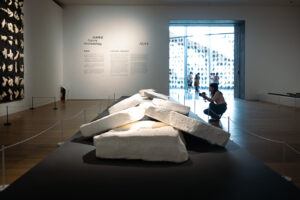
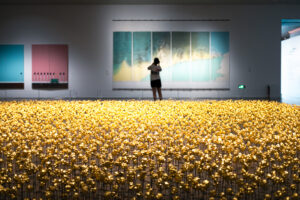
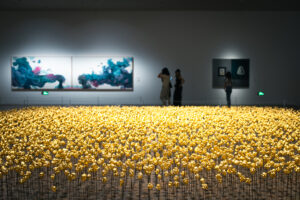
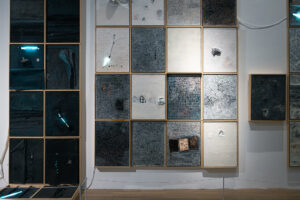
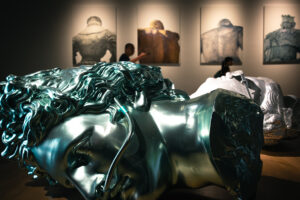
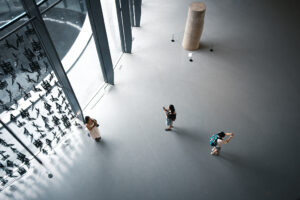
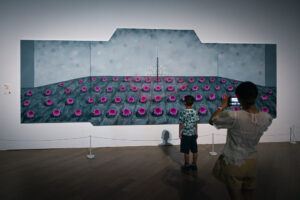
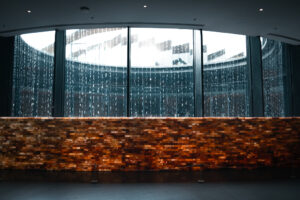
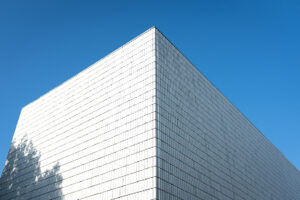
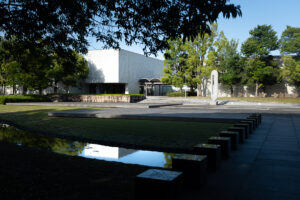
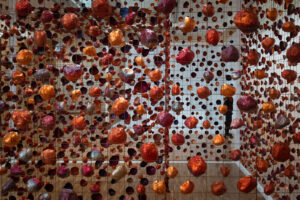
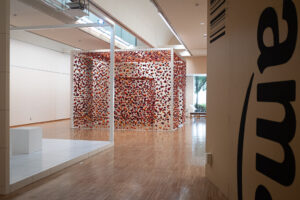
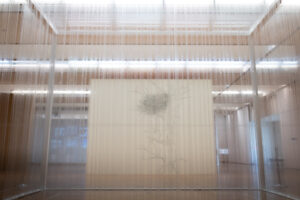
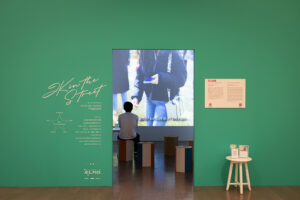
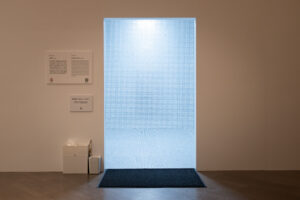
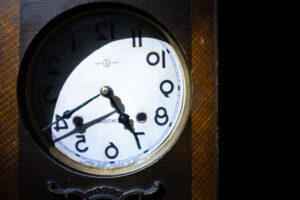
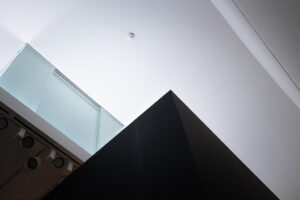
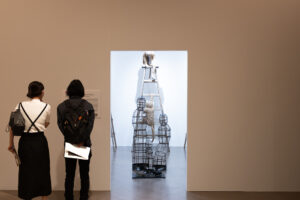
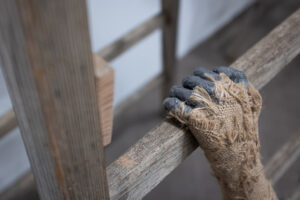
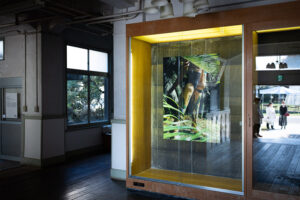
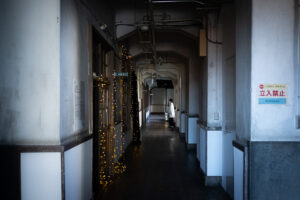
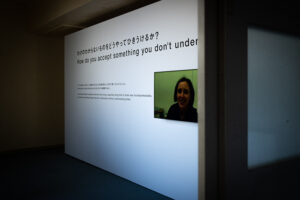
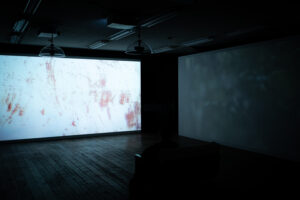
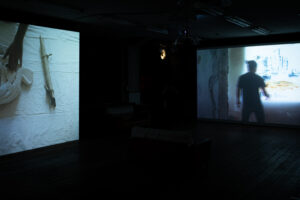
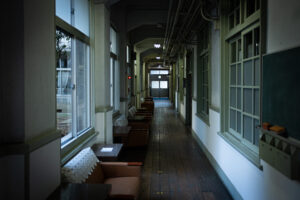
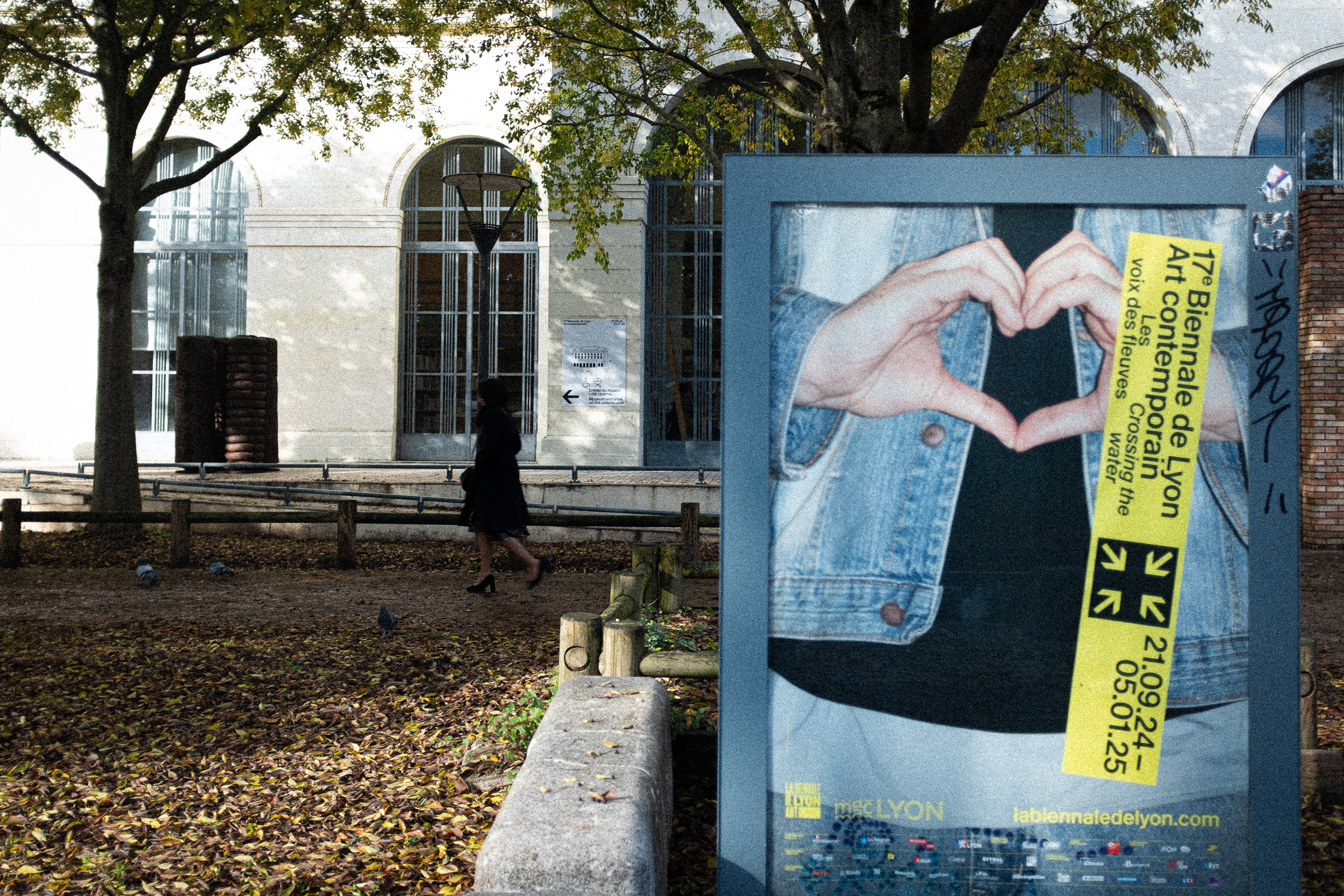
    We would like to present to you a photography essay documenting the 17th Lyon Biennale: Les voix des fleuves, Crossing the water. The first instalment centres on one of the main venues at the Musée d’Art contemporain de Lyon (macLYON). Designed by Renzo Piano, the museum initially opened its doors in 1984 before relocating in 1995 to the Cité Internationale, an extensive architectural development positioned between the Rhône River and Tête d’Or Park.

    Please refer to the following chapters for the rest of the essay: La Presqu’île; Les Grandes Locos; Institut d’art contemporain de Villeurbanne.

    Stepping out of Lyon–Part-Dieu, the stench of piss in the air and cloying, shitty perfume hits you immediately like a slap in the face. Locals striding past with permanently furrowed brows; tourists with their 65-litre backpacks strapped to the backs and another 30 up front like overpacked mules; Riders on scooters calmly weave through it all, balancing a cigarette in one hand and a coffee in the other. Rubbish overflowing from virtually every single bin — voilà, you’re in France.

    This is the second time I’ve set foot in the city of Lyon. The first was seven years ago, in a warm, sunlit April, back then we had just wrapped up our project for the St-Étienne Biennale, and a couple of the boys and I took a quick train ride around noon from that quiet town into the city. We were sipping a chilled glass of Sauvignon Blanc, enjoying a classic tripes à la lyonnaise near the Vieux Lyon by the Saône River. People had their sunglasses out, with beaming smiles on their faces that seemed to require no effort at all. Whereas today, it feels like a drastically different organism altogether, like I have just flipped into the Upside Down. Faces have hardened, trees are turning yellow with scattered foliage everywhere, the sky is grey, and the chilling rain cuts straight to the bone. How strange that is, a city can remain the same on a map, yet the entire atmosphere changes the moment the season breaks.

    For many kids growing up in the 80s and 90s in Asia, there was this, automatic fascination with, and aspirations toward the West, Europe especially. The mysterious spiky castles, the grey cobblestone streets, houses with slanted roofs tiled in every shade of colour, Christmas lights, and the idea of eating a thick chunk of bloody steak with a knife and a fork, swirling a glass of red at the table while a blonde girl or boy with deep mesmerising blue eyes sat across from you. A whole book of romantic imaginings with curiosity and fantasy written all over the pages.

    In my childhood years, whenever my aunt returned from London, I would be dying to eat those Toblerone and Loacker Quadratini she brought back, almost ceremoniously, savouring every last crumb, it was just unlike anything I had ever tasted back then, to me, they were out of this world — they were from the West. I would follow my aunt from room to room, telling her everything I knew to try to impress this distant relative who lived elsewhere, in the West, being the only one in the family. I also remember when my mother had the opportunity to visit Europe, I would urge, demanding she photograph and print out everything she saw, all the sights, whatever scenery, I kept all those photos with me, looking at them over and over again, to a point where certain images were morphing into familiar places I felt I had already visited. And of course, there was the bragging part too.

    So when my mother later asked me if I wanted to be sent abroad to the UK for studies, I said yes in a heartbeat. That was the destination, that was the dream of a thirteen-year-old who had never walked outside Chinese borders, even though it meant leaving family and friends, and whatever version of myself existed back then behind.

    Now, slowly turning 40 myself, having lived and travelled across Europe for some twenty-odd years, and fast-forwarding through another five-plus years in the Land of the Rising Sun, returning now to France in a cold, bleak November post-COVID, it becomes apparent, that it’s not only the years and the seasons that have changed.

    The baguettes bite like jaw-muscle training, a couple of days in, you could feel the tension and the muscles aching; trains are hopelessly delayed at the slightest dusting of snow; millions of cigarette butts are permanently glued to the train tracks; Wi-Fi fails more often than it works, and houses look as if they’re on the verge of collapse with their decaying façades. Once perceived and imagined, in the eyes of an Asian boy, as a spirited and elegant young man, full of style, brimming with confidence and momentum, destined to age slowly and gracefully over many many years to come, Europe now already looks more like a war-torn, frail, ugly cranky bastard with a fat bloated belly, far far removed from a wise old sage, always impatient, endlessly whinging about life, yet doing very little to change it.

    That feeling lingered and permeated, quietly seeped into everything, carrying through to my visit to the Biennale at the macLYON on my first day.

    In order to get to Lyon-Part-Dieu, the city’s main train station, mind if I add, all it took was a minor pilgrimage on the Eurostar from London to Gare du Nord in Paris, a transfer via the crowded, chaotic, last-century Paris Metro, whether the ticket barrier chooses to respond and flash the gates open is a pure matter of chance, regardless of how religiously you hold your phone against it; then on to the cavernous Paris Gare de Lyon, before one final two-hour train ride down south. Just as you were about to breathe a sigh of relief for making the train on time, a group of hoodies and sweatpants piled into the carriage with their disgusting laughter, and you just knew, this was going to be a serene and pleasant journey, much like riding the Shinkansen from Nagoya westward to Hiroshima and beyond. By the time you arrive in Lyon, night has already fallen. Good luck finding your Airbnb as you squint down at Google Maps on an empty stomach in the dead of winter, all while keeping one eye out for pickpockets and another for phone snatchers.

    No, it wasn’t pleasant, are you kidding. And I have to say, it wasn’t easy. Not at all, despite my years of experience travelling around Europe. In fact, getting to a biennale has never been an easy task, domestic or otherwise. It means miles upon miles on the road, jostling through the crowds while trying to actually take in the artworks, figuring out what needs to be photographed and jotting down notes into your phone — layering it all with an amalgamation of fatigue, irritation and frustration, along with a constant undercurrent of emotional overload nagging at the back of your head that’s impossible to shut off, at some point, you just can’t help but wonder: what the actual fuck am I even doing here?

    Enough with the whining, that’s more than long enough for an introduction, and for the sake of it, I should still utter a few words about the Biennale itself.


    Established in 1991, the Lyon Biennale sits among some of the longest-standing bi- and triennales in the world. Entitled Les voix des fleuves, Crossing the water, where the first part literally translates as “the voices of the rivers”, which somewhat reminded me of a rather underwhelming art project that took place in Nagoya, Japan, in 2022 titled, Streaming Heritage: Between the Plateaus and the Sea. Both projects utilise a river cutting through the city as the backbone of the exhibitions, the latter pivots more toward tourism promotion and area revitalisation, whereas the former employs the river as a metaphor for exchange as well as the nurturing of relationships between individuals. That in turn leads us to the theme of the Biennale, to quote the curator: “… to interrogate and to investigate the subject of the waxing and waning relationships of human beings with one another and with their environment.”


    Grumblings aside, the Biennale was great in the sense that the production was executed brilliantly and everything else was handled professionally, likely to some of the highest standards, ticking all boxes, from the curation of some excellent works of global artists, to community practices that embrace localism, getting volunteers involved and all that — beautiful narrative, truly.

    In macLYON, Nadav Kander photographs a family of five in Chongqing, China, having a Sunday lunch at a dining table set beside the Yangtze River, a culturally immense and geographic wonder that stretches roughly 6,300 kilometres across the country from west to east. Resonating well with the broader theme and title of the Biennale, it is a brilliant start, tinged with humour and a subtle absurdity through a Western lens. The work is thoughtfully set against the photographic works by Chinese artist Dan Luo, shown in a nearby hall and created in 2006, the same year as Kander’s, which observe two generations living at the edge of the Yangtze near the Three Gorges area in Hubei. The images are a fine attempt to grapple with the overwhelming scale of the river and the surrounding rural landscape, through a far more intimate perspective.

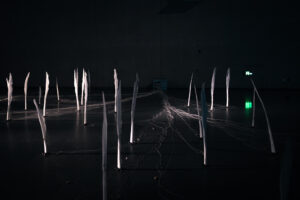
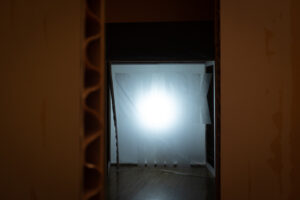
    Drawing on personal memories, Taysir Batniji’s Disruptions (2015–2017) is a series of pixelated, frozen screenshots taken from interrupted WhatsApp video calls between the artist and his family in Gaza. In an ostensibly hyper-developed modern digital space, with AI looming above everyone’s heads, human connections, albeit intimate, remain rather fragile. Batniji’s stories are further elaborated in Al-Anqâa (The Phénix) (2024), where viewers are invited into an installation set in a pitch-dark room, in which fluorescent lines trace the map of Gaza across the floor. The work renders the city’s traumatic experience shaped by prolonged power outages and widespread destruction.

    Stumbling upon Le Voyage de Noces (The Honeymoon) (1975) is, at first, a pleasant surprise. The autobiographical mural installation, composed of 21 drawings and 86 photographs created collaboratively by Annette Messager and Christian Boltanski, grants viewers a rare opportunity to peer into the couple’s overtly private and personal honeymoon trip to Venice. However, the work, produced in 1975, feels unmistakably like a relic from a distant past, well removed from the couple’s best works. The whole thing’s idea is elevated to leaning into the clichés of Venice as the city of love, undermining conventional ideas of romance and intimacy, “questioning the commonplace assumptions about love relationships.”

    Well. I personally see none of those.

    Although aesthetically exquisite, capturing a moment in time elegantly, if one strips away its art-historical framing and context, many of the images could easily pass for souvenir goods. In today’s world, where millions of similar images and drawings are uploaded to social media on a daily basis, exhibiting this work in a biennale in the year of 2024, further highlights how names and reputations sometimes can speak much louder than the quality of the work itself, exactly like the celebrity culture that dominates today. In that sense, I guess the work does still speak relevance.

    Chantal Akerman’s black-and-white video work In the Mirror, based on her film L’enfant aimé ou je joue à être une femme mariée (The Beloved Child, or I Play at Being a Married Woman) (1971), closes up on a woman confronting and criticising her reflection, while Lyz Parayzo’s Cuir Mouvement (2024) takes the form of suspended metal sculptures shaped like jagged, circular saws that oscillate between danger and protection, in a room devoured by pink illumination entirely. Both works examine the relationship one has with oneself, despite the different mediums and eras of the artists, revealing how one’s own body becomes a site of internalised judgement as well as resistance under social pressures.

    Around 25 artists exhibited their works at macLYON, many of whom live in France. Without detailing each one of the works, the exhibitions at the venue focus in particular on “the human relations between friends, families or lovers”, extending also to one’s relationship with oneself. The wide array of artworks apparently justifies and corresponds well to the overall theme, but did it cause any ripple in the heart? I’m afraid not — a shiver at best. Everything was played extremely safe, it neither sought to experiment nor to provoke, it stayed within the boundaries of political correctness, to a degree where it feels like everything was simply, just there, like a dull picture hanging in a kitchen, to please visitors and for them to snap a billion I-was-here pictures for social media.


    The thought that clouded my head during my visit, was none other than why the human race needs quite this much mediocrity of art, together with the global sprawl of art fairs, biennales, triennales, exhibitions, events and projects, the amount of boring art projects being produced is beyond staggering. Restaurants and food, yes I get that, we as a human race love to chew on fat and indulge, given our pathetically short lifespan, but tens of thousands of art projects on a globalised scale, annually? Come on already.

    Without a shadow of a doubt, biennales do draw people to a city, or even help revitalise some rundown town, Setouchi and Echigo-Tsumari are textbook examples. Whether the Venice model can be copied and pasted onto every single city, and whether it keeps the local economy sustainably afloat and all the hotels booked — I’m not sure. But simply consider that, and often without many realising it, the sheer amount of effort and the substantial finance it takes to actually realise an art project, the enormous production, the logistics and coordination, the materials and time and human resources that have to be poured in, not even mentioning more than half of it will end up in a dumpster once the project concludes, all while the world outside grows visibly much shittier as days go by. Numerous wars are breaking out, actual wars — civil wars, international wars, a pervasive erosion of global peace, rising geopolitical and economic tensions, underlying structural issues like an ageing population and outmigration, must I go on?

    2025 is right around the corner, and the world is deeply locked into in a shitstorm, and I wish that maybe, just maybe, one of the artists presenting at these biennales could explain to me why humanity needs so much art right now. But I guess it doesn’t truly matter to them as long as the invoices are cleared and the paycheques arrive on time. “Art is life”, that’s still a motto I wholeheartedly swear by, however, at this point in time, perhaps it’s time we examine life from some other perspectives, something has to change.

    I arrived in Lyon with the noble intention of looking at art, and left each day doing something, well, let’s just say humble and sincere. After walking through rooms and rooms of largely forgettable and mediocre art (except for Oliver Beer’s Resonance Project shown at the Grandes Locos), the second I stepped out of the exhibition venues, I hit Google Maps and searched for bouchons. The only thing I craved was not another blasé concept statement that I’d already read a million times elsewhere, and frankly written a hundred myself, nor another pointless installation to “immerse” myself in; I needed something warm, something red, and something reassuring, a reminder that I was still alive and well, amid the shit of a world we are all living in today.

    Because restaurants and food, unlike so much of what I had just seen, do not pretend to question the world, it merely nourishes, and sometimes, that’s more than enough. And if there is one thing left that this grumpy old fart still knows, and knows well, it is the unpretentious mastery of a well-cooked meal and a properly poured glass of wine. For now, at least, that feels like true wisdom.
     

  • Yokohama Triennale 2023 “Wild Grass: Our Lives” — Chapter 2 | Yokohama Museum of Art

    Yokohama Triennale 2023 “Wild Grass: Our Lives” — Chapter 2 | Yokohama Museum of Art


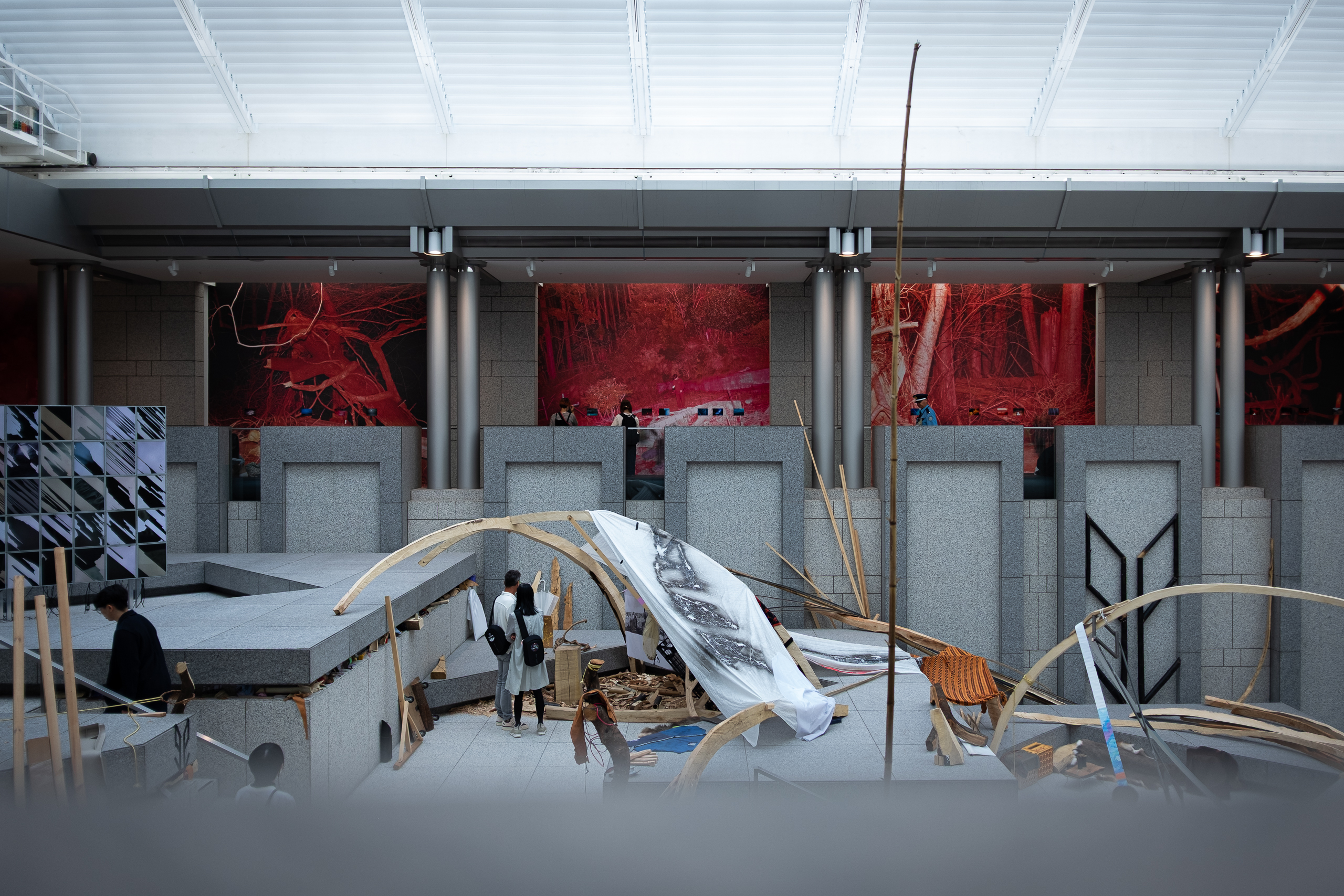
    Once you make your entrance to the museum on the second floor, it feels almost as if you are stepping into the lobby of a grandiose modern hotel, one that could make its way into The White Lotus. Instead of Corinthian columns, colossal marble statues, and crystal chandeliers hanging from the ceiling, you are greeted by a sculpture of colliding human bodies and red beetle-like textile installations floating overhead. Before you have even had the chance to breathe, a sharp siren cuts through the space.

    The siren comes from a video installation partially occupying the mezzanine between the second and third floors, like a square fountain, dominating the centre of the opening chapter, which shares the same title as the Triennale itself: いま、ここで生きてる — “living here and now”. The work features refugees from eastern Ukraine recreating the sounds of war and the weapons they have learnt to recognise, like a karaoke lesson.

    “From the moment we hear the first air raid siren, our ‘internal alarm’ is on alert. It keeps us in constant tension and makes us listen to every sound, every rustle. Sometimes suspicion creeps in even in silence.”

    As the centrepiece that virtually everyone is bound to experience, it certainly marks intent. On the other hand, It is, dare I say, annoying as fuck. Again, the intent is clear, and literally quite loud. It asks what “here” and “now” actually mean when everyday life is measured by the sound of an air raid siren and various weapons. Discomfort is precisely the point. The refugees cannot simply walk away from those sounds, unlike the visitors in the museum. The sirens repeat over and over again, as the video loops over and over again, my only instinctive reaction was just to pull its plug and run away.
    Obviously I didn’t want to get kicked out, and unfortunately I couldn’t just run away. The sound lingered and echoed well beyond the installation itself. Moving between galleries, it became increasingly difficult to focus and separate one work from another as different soundtracks drifted across rooms, overlapping, interrupting one another, and occasionally collapsing into noise. At rare times this created unexpected connections, at most times, however, it was dreadfully exhausting. What added more fuel to the Fire in the Woods (pun intended), was that one installation created by an avant-garde Japanese artist in 1955, which has become an almost guaranteed presence in every Gutai exhibition. The work does nothing but emit a sharp sequence of metallic rings, causing everyone to flinch, pull their hands away, and look around confused, convinced they had accidentally touched something they shouldn’t have, but just didn’t know what. Watching the visitors react and panic, by this point, had become far more amusing than the actual installation. On a side note, apart from a handful of video works, for better or worse, there was remarkably little to no engagement with digital culture or artificial intelligence at the exhibition, almost like a deliberate avoidance, despite AI being one of the defining conversations of the “here” and “now”.

    The entirety of my visit, almost 240 minutes, had gone by in a kind of numb blur. Would I go as far as calling this edition of the Yokohama Triennale another commendable but ultimately lacklustre attempt by Japanese public institutions to churn out yet another contemporary art event? Probably not. Individually, many of the works were excellent in their own right. Together, however, they feel less like a conceptually curated album and more like a random playlist of tracks from the same genre. Did I encounter anything that triggered something in my brain, or something that disturbed the heart, as Jerry Saltz once described the power of art? Well, the noise certainly did disturb, just not in the way I had hoped.

    How much had changed: the curators had changed, the city had changed — to a certain extent — some of the restaurants in Chinatown seemed a little more authentic, whatever that word means these days. I had changed too, if only by growing older. Yet something, I felt, had not.

    Whether the final exhibition represented a watered-down, softened, comfy version of what the curators had originally envisioned, or whether institutional realities inevitably moulded its outcome — as often as they do, contemporary art exhibitions on this scale hardly escape politics — there’s no way to find out. It is easy to discuss censorship by pointing fingers towards the likes of the PRC, but most countries, Japan included, have many, many of their own invisible boundaries. Aichi 2019 ringing any bells?

    I’m not implying censorship here per se, but for years, I have lamented that many biennales and triennales, or even art projects in Japan, are like Disneyland or, if you prefer, the Universal Studios Japan equivalent of contemporary art. They are like a merry-go-round, you are strapped into a safe seat, watching the world’s fractures spin past from a comfortable distance. Despite the gentle ups and downs, you are never allowed to climb off and touch anything. There is, of course, nothing inherently wrong with a merry-go-round, nor must every exhibition turn into a political manifesto. But sometimes, the most memorable experiences aren’t the safest ones. Sometimes, you don’t just want to watch the hurricane from afar — you want to stand close enough to feel the wind, to almost taste the danger. Powerful art and curation don’t always have to comfort, sometimes, they should pull us close, regardless of how uncomfortable it may be.

    Many have argued that Lu Xun never really wanted or expected anyone to fully understand Wild Grass, that this personal collection of solitary conversations belonged to him, and him alone. Fair enough. Reading the collection again, more than twenty years after first encountering it, embarrassing as it may be, even now, I still couldn’t honestly say that I truly understand it. Lu Xun’s words have always felt grim to me, there is always a faint scent of despair seeping through the lines, but so too an extraordinary sense of resilience, that even when hope has disappeared and the world has fallen into shit, one must still put one foot in front of the other and keep moving. How do you take that on as the overarching theme of an exhibition? The Triennale appeared to promise something different at first, as it brought together a diverse lineup of artists touching on war, labour, displacement and society, hinting at an exhibition willing to confront the present head-on. Everything was neatly organised and professionally produced. The credits were all there. The job, as always, was done. As joyous and comfortable as a merry-go-round may be, I think it’s time we seriously consider finally stepping off the ride and marching on.


  • Yokohama Triennale 2023 “Wild Grass: Our Lives” — Chapter 1 | Yokohama Museum of Art

    Yokohama Triennale 2023 “Wild Grass: Our Lives” — Chapter 1 | Yokohama Museum of Art

    We would like to present a photographic essay documenting the Yokohama Triennale 2023, Wild Grass: Our Lives. The first instalment centres on the Yokohama Museum of Art.

    The eighth edition of the Yokohama Triennale concluded not too long ago in June 2024. Originally scheduled to open in December 2023, the Triennale was postponed due to the global semiconductor shortage, eventually welcoming visitors on 15 March 2024. The revised opening date also coincided with the grand reopening of the Yokohama Museum of Art, designed by Kengo Tange1, following a three-year renovation.

    I vividly remember my previous visit to the museum during the last edition of the Triennale in 2020 under a light drizzle, one of those damp late-summer afternoons. The entire front façade of the museum was hidden behind some sort of enormous purple veil. Whether it was part of the renovation works or an installation commissioned for the exhibition, I wasn’t really sure. The rain certainly added to the mystery, and the lines are often pleasantly, or sometimes frustratingly, blurred these days in the world of contemporary art, as we all know.

    More than three years later, the veil had disappeared. The museum had reopened. The pandemic had already become a relic of the past. Tourism in Japan had resumed and surged, and I found myself back in the city of Yokohama once again. Artistically directed by Liu Ding and Carol Yinghua Lu2, the Triennale is titled, Wild Grass: Our Lives / 野草:いま、ここで生きてる, sharing its name with the anthology of prose poems Wild Grass (野草), published in 1927, written by the renowned modern Chinese writer Lu Xun3, arguably one of the defining figures of modern Chinese literature. Twenty-odd years later, the Triennale unexpectedly offered me another opportunity to revisit the works of Lu Xun, and this time, I would love to see whether the text had changed, or perhaps I had. On the Shinkansen from Nagoya to Yokohama, I tried to recollect and piece together everything I could remember about the book. I must have been twelve, or even younger, when I first read it. And man, I hated it.


    “Could you just write properly like a normal human being without being so pretentious?”


    I guess it’s fair to say that’s simply what happens when you’re a teenager. Your opinion matters, perhaps a bit too much. The old stuff feels far less significant than the concerns of your own small world, and when the classics are simply shoved down your throat, you are never ready. I remembered there being quite a bit about dreams in the book, one dream within another. Full of allegories and symbolism, so I was taught. There were lots of binary oppositions: dawn and dusk, hope and despair, etc., and of course there was that famous, or infamously notorious line that all of us at school once loathed and despised, being teenagers and all that:


    “I can see two trees. One of them is a date tree; the other is also a date tree.”


    It is one of those lines that almost every Chinese student remembers, not because everyone thinks it is a brilliant line, but because nobody quite knows what to do with it. What does it even mean?

    Now, the curators, who were perhaps also, equally mesmerised by this strange line of text. In turn, the Triennale was crafted in much the same way, with the existence of one thing reflected in two separate things. Namely, the exhibition plan. The presentation at the Yokohama Museum of Art was organised into six principal chapters. Two of them, Fires in the Woods and My Liberation (ironically, photography wasn’t allowed here), appeared twice at opposite ends of the third floor in a mirrored arrangement that utilised the museum’s symmetrical plan. Streams and Rocks and Dialogue with the Mirror occupied the two extremities, while Symbol of Depression sat right in the centre.

    Before even stepping inside the museum, however, visitors would undoubtedly encounter the Triennale’s unorthodox lettering set against a purple background. The visual identity set the tone, and could be seen as another interpretation of Wild Grass. The typography resembled hurried handwriting, almost as if it were deliberately resistant to graphic standardisation. Without diving into the designers’ conceptual framework, it looked fun and somewhat different and refreshing, felt entirely appropriate for an exhibition borrowing its title from Lu Xun, and effectively served the purpose. Let’s leave it at that.


    TO BE CONTINUED…

  • Saitama Triennale 2023: We | Former Omiya Civic Hall

    Saitama Triennale 2023: We | Former Omiya Civic Hall

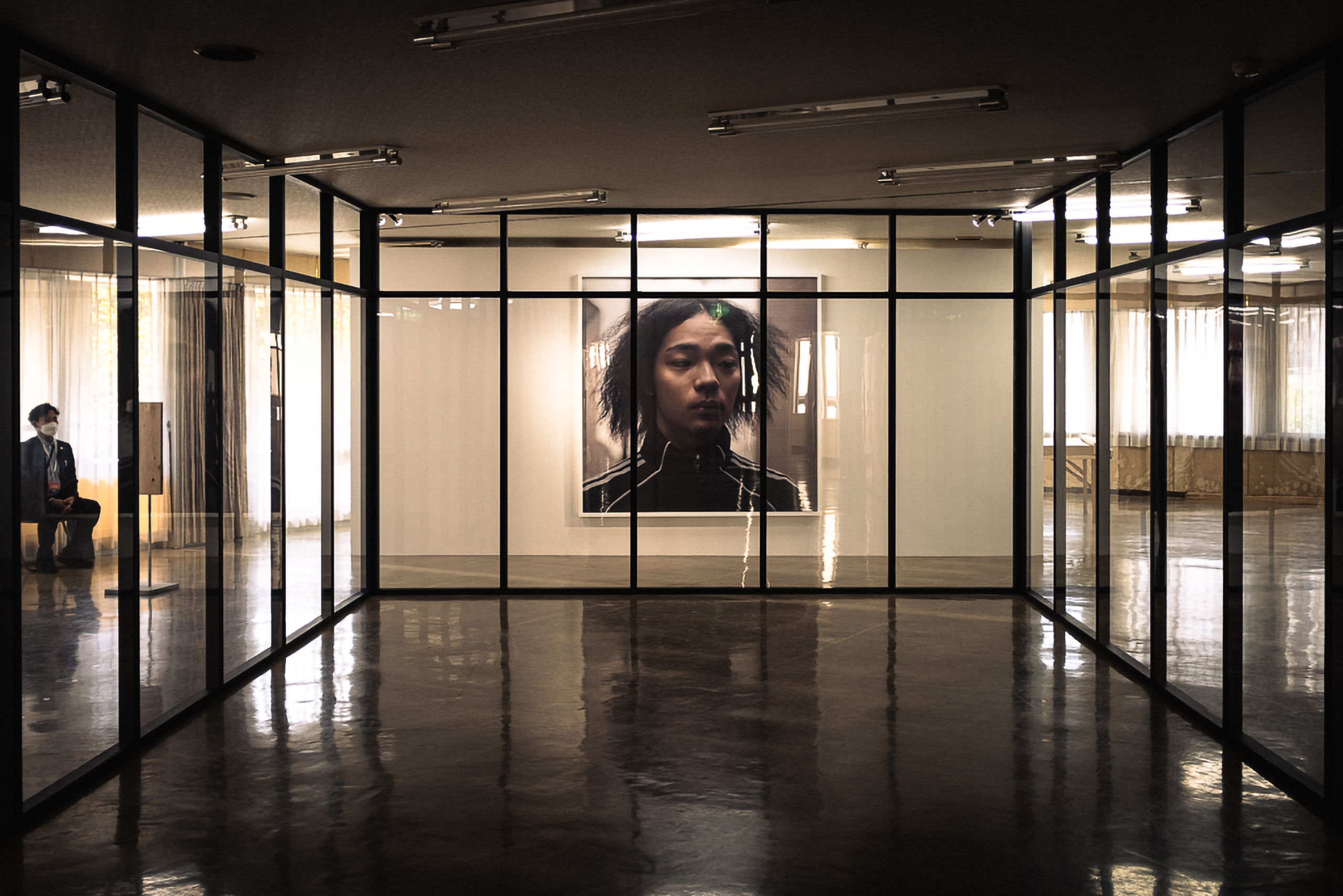
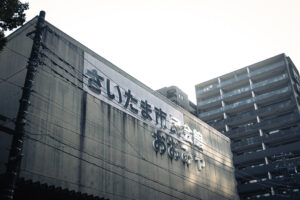
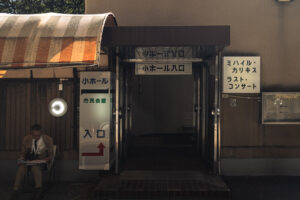
    This year’s Saitama Triennale: We is directed by the Japanese contemporary art collective mé (目). The exhibition is housed in the Former Civic Hall in Ōmiya, one of the Triennale’s main venues, in Saitama Prefecture, Japan.

    I found myself in Saitama after a 40-minute train ride from Ueno. Perhaps one of the least romantic prefectures in the country, there isn’t much I know about the place other than a handful of stereotypes: the Kurdish community occasionally making the headlines, the growing number of so-called authentic Chinese restaurants and its growing community, Kawagoe apparently being “Little Edo”, and, oh, Saitama also being the hometown of Kojiro Hyuga from Captain Tsubasa, which, of course, isn’t saying much.

    And completely irrelevant too, but that probably just tells you how much I actually know about the place.

    Coming back to the Triennial, and just to sum it up, the Triennial rejects the notion of a conventional exhibition model, where objects or works of art occupy designated spots or locations mapped across a city, in which the visitor’s goal is to tick off every work, in every room, in every venue. Instead, it privileges serendipitous, supposedly irreproducible experiences unique to each visitor — no names, no texts, no plinths, only the occasional greetings from the volunteers as you cautiously tread through one exhibition room after another, after the initial phase of confusion upon stepping into the exhibition hall.

    Coming back to the Triennial, and just to sum it up, the Triennial rejects the notion of a conventional exhibition model, where objects or works of art occupy designated spots mapped across a city, and the visitor’s goal is to tick off every work, in every room, in every venue. Instead, it privileges serendipitous, irreproducible experiences supposedly unique to each visitor — no names, no texts, no plinths, only the occasional greeting from a volunteer as you cautiously tread from one exhibition room to the next, after the initial confusion of stepping into the exhibition hall.

    The ethos of it all, essentially, is very much aligned with the practice of the art collective mé (目), whose works, by and large, are neither physical objects nor spatial installations, they are more site-specific conditions and contingent experiences of perception. Like the conceptual art movement of the 1960s, it’s ideas over objects, unlike conceptual art, however, the idea or concept exists to heighten experience and perception, while the location itself is inherently an active participant in the work. And if I were to sum it up again, in the simplest terms, conceptual experience might be right, if, that makes any sense.

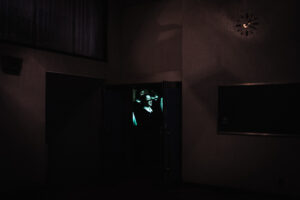
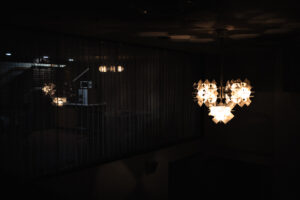
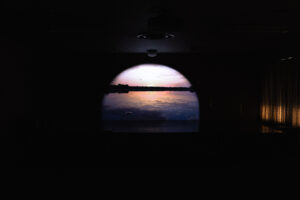
    We are presenting a photographic essay documenting the main venue of the Triennale below. The essay serves to capture the atmospheric qualities of the exhibition, far removed from a comprehensive record, on the other hand, the essay only offers fragments of the encounter. What remains outside the frame isn’t a lack but precisely the point, every act of looking is also an act of missing, every corner opens onto another, every certainty seemingly dissolves into something half-glimpsed, echoing mé (目)’s vision of the festival “…where it is impossible to see everything.”


  • 2023 Chengdu Biennale: Time Gravity — Chapter 3 | Chengdu Art Museum

    2023 Chengdu Biennale: Time Gravity — Chapter 3 | Chengdu Art Museum


    Where was I?

    Right. So.

    The “original” meaning of the artworks has ceased to exist, and the rules of looking at art are being rewritten.

    Now, these images on our social media grids serve no purpose other than documenting and announcing our existence to the rest of the world — as if the rest of the world cares — all the artworks in this economy of visibility have been reduced and turned into photo opportunities (Scott Reyburn, 2018)1 and skeletal backdrops for dumb selfies. Eugene Rabkin wrote in 2019 perfectly describing this crowd: “…what he is interested in is the right image, the right brand, the right Instagram selfie. He wants to stand out and fit in at the same time. He wants to be cool and socially accepted at the same time. He wants to be an individual who is a part of the mass.”2 Exhibition spaces are diluted into playgrounds for snapping one picture after another, one selfie after another, an I-was-here picture in front of an artwork is like a form of social currency that, “…enables a person to influence and manage the perception of themselves, by others.” (John Dean, 2021)3. As people parade their overpriced tastes to feel important or cultured, jumping through gallery halls not to look or to be enlightened, but to be seen looking, that is not cultural participation, but pure, self-centred narcissism.
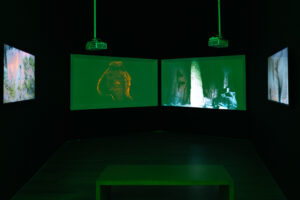
    I find that, unbidden, temper and annoyance seem to arrive with disconcerting ease in the aftermath of the pandemic. It feels as if, overnight, an extra billion people were released into the world from their mothers’ wombs, fully grown but probably not so much in their heads — fuck me, there are people everywhere now. What’s worse, it’s apparent that the collective sense of compensation has kicked in, there’s that urge to reclaim lost time, and museums and other cultural establishments have become prime hunting grounds for this frenzy. A photo in front of Mount Fuji — you are just another dumb tourist, but posing beside a grandiose abstract painting by a Japanese artist? It tells a whole different tale. Having already encountered the images on their phones, the swarms of locusts are ready to descend, cameras raised, and the hunt for the pre-scripted images begins.
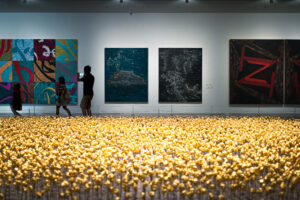
    And boy, the museums smelled them too, traps are baited, gates are open.

    Rick Owens once said that going to a museum feels like going to church for him, I don’t go to church but that sentiment is shared. Museums are like my haven, places where I can escape to, places where I can be awed and cleansed, they are the society’s cultural gatekeepers, the taste makers who define how art and objects are presented and experienced, as well as what is legitimised as art in the first place (Steve Lohr, 2014)4.

    The etymology of the word “museum” derives from the ancient Greek “mouseion”, meaning a place dedicated to the Muses, a site of learning and contemplation, in other words, from its very inception, the museum has assumed the role of a guardian of human knowledge. Yet this sense of sanctuary is inseparable from institutional authority. We’ve probably all heard it from that one friend at the dining table one night after a few drinks, that museums are just a load of elitist bollocks. Well, he or she is not entirely wrong and yes, this guardianship has never been be neutral and probably never will be because, systems of knowledge and systems of power often come hand in hand, as Michel Foucault would like to remind us, the acts of selection and classification, curation and hierarchy, are essentially, forms of disciplinary power in themselves.

    Building on this, scholars like Tony Bennett and Eilean Hooper-Greenhill discuss how, conventionally, museums construct a “pedagogical space”, environments which actively confine visitors as spectators rather than participants through the use of display cases, labelling, lighting, and security measures, all conspiring to create both a physical and symbolic separation, a subtle but firm lookie-no-touchie zone reinforcing institutional authority and creating an implicit “barrier” to direct engagement between the viewer and the artworks.

    Either way, that’s not the point I want to raise. Foucault should not be what’s on the table right now, so let’s try this again.

    In the digital age, museums started to embrace themselves more as entertainers for the masses, in lieu of producers of meanings, perhaps less by choice than by sheer necessity of the times. Especially after COVID — it was like a dagger to the heart to so many institutions and establishments, it’s not really about sympathy here but I mean, can you blame them really?

    Exhibition content is now designed almost categorically with social media aesthetics in mind, a trend that has intensified with all the bloody immersive exhibitions on the rise — here’s a piece of “experience” that you’ve never experienced before, snap a pic and off you go. The ideas and intentions of the curators, which (supposedly) developed over weeks if not, months, then distilled into and articulated through the (supposedly) meticulously crafted wall texts, somewhat fade into irrelevance. Spectators are not simply there to complete the work or the exhibition as Duchamp proposed, they are the centre of the exhibits now, appearing on everyone else’s photo feeds, what lies in the background of the photo is merely interchangeable content, as long as it’s visually pleasing.

    Whether these types of exhibition still operate within the same underlying structure of control is, once again, beside my point, but let’s say, for argument’s sake, that they no longer do, that this invisible wall between audience and artwork is dissolving, what emerges instead is a fundamentally altered intention on the part of the visitor. When you step into an exhibition, immersive or not, what’s the first thing that crosses your head? Exactly — how do I get the best shot? Or worse, forget “the best”, you snap away a dozen shots hoping one of them might eventually do the trick. Rather than a desire to discover and to learn, the locusts are only focused on asserting existence by relentlessly harvesting images, deflating the works to trivial consumables for easy digestion with the self placed squarely right at the centre.

    This shift in the mindset of both the museums and the spectators inevitably produced another spectrum. The artists ain’t dumb, if anything, they are probably among the most sensitive players in the game, and of course they would pick up the trend. Attention gradually began to recalibrate from form, expression or inquiry, towards impact and visibility: how a work performs in a space, how it is photographed, how efficiently it can deliver an “experience”. Remember Zombie Formalism? If you don’t, look it up — in fact, don’t. The movement proved to be nothing more than a bubble, one that naturally bursts for no reason other than the fact that the works themselves were utterly hollow bullshit. And it’s safe to bet the artists knew precisely what they were producing.

    If the museums are the gatekeepers moulding our senses of aesthetics and beauty in the contemporary world, that standard has undeniably been blurred by the flood of circulating images. The more images there are, the more museums measure it as an opportunity to sell more tickets, the more shitty, like-generating, mediocre content is produced by the artists, the more identical pictures get taken, and the vicious cycle doesn’t end.

    If snapping a photo helps you engage with the work, then by all means, go right ahead. But we all know that won’t be the case. Most photos you take of artworks just sit in the Photos app, occupying storage space, until one day, when on a flight with no network and a few hours to kill, the screen lights up, and you take an inventory of your life as you scroll through those terrible photos you’ve taken, with no recollection of the art or the experience whatsoever.

    At the very opening of this piece, I started with something, well, rather mean and nasty, it was a conscious, though shameless, mimicry of Thomas Ricker’s initial lunge in his piece Stop Being a Tourist. In closing, I would like to return to the same article, where Ricker had a moment of epiphany while watching the crowd swarm the Mona Lisa with their cameras at the Louvre, and wrote: “I realised then that staring at something beautiful through a 4-inch window isn’t appreciation, it’s voyeurism.”5

    To see is to see what you do not see, to understand that you do not understand. I don’t pretend to know how to break the cycle, but here’s a start: put down your fucking phone, see the art.

  • 2023 Chengdu Biennale: Time Gravity — Chapter 2 | Chengdu Art Museum

    2023 Chengdu Biennale: Time Gravity — Chapter 2 | Chengdu Art Museum


    To begin, we must first address how one engages with an artwork, contemporary art especially. Primarily we engage by looking, and yet looking is never neutral. As John Berger famously wrote, “We never look at just one thing; we are always looking at the relation between things and ourselves.”1 Berger would say that we never encounter an artwork in isolation, it exists within a dense web of culture, memory, and even ideology. The artwork is not merely an object sitting in front of our eyes, this encounter itself is shaped by power, context, and our own position as viewers.

    But today.

    Our encounter with art is now almost, always mediated by smartphones, through the phone camera’s lens, its aestheticising filters, and the unseen algorithms that sit quietly in the background like a dark, invisible mediator governing what is allowed to surface and what slips into obscurity. Berger once noted that mechanical reproduction dramatically reframes an artwork’s meaning, his logic extends naturally further in a similar vein, such that today, each smartphone image becomes a new iteration of the original work, an edited version that’s instantly shareable. Perhaps less a reproduction than a mutation with every capture, entering a stream of images in circulation competing for attention, rather than contemplation.

    As these mutations travel — and they travel fast — a bit like COVID, they behave less like representations of originals but more like signals, quickly absorbed, and quickly replaced. You don’t linger over them, not only because your attention span is already fucked but, what’s there to linger on? Meanings have multiplied tenfold, not by deepening but by spreading, the authority of any “original” meaning is essentially destabilised if not, completely destroyed and erased (James Bridle, 2014)2.

    Art, has gone full-on mobile.

    In 2014, critic Matt Trueman wrote that “screens have replaced the page and the stage,”3 and he’s spot-on, even more so nearly a decade later. For many of us, be it curator or artist, collector or spectator, we now meet artworks on our screens first, well ahead of any physical interaction in person, if that ever happens at all, the image eclipses both the object and the experience.

    I recall a conversation I had some years ago with Jinhui Wang, a London-based digital artist born in 1997, who said that for her generation, the use of a computer mouse had become second nature, it’s like an extension of the arm itself. The smartphone nowadays plays a comparable and more intimate role, we’re so utterly accustomed to encountering art through devices that we expect nothing less, and nothing more — art must come to me and not me going to it. Our viewing and aesthetic interactions are compressed into and redirected toward the scope of a screen, such that, “experiencing art through it feels as natural as any other interface”4, as Trueman rightly suggested.


    So how do we engage with art in today’s world? I think by now the answer is uncomfortably but blatantly obvious: we see via our screens, and we engage by photographing them. Berger’s insight — that we never look at just one thing — has acquired a new dimension. Through the framing device of a phone, we now look at the relationship between objects and ourselves, alongside the networked audience we carry on this phone in our pockets, which in turn, frames not only what we see, but how we expect others to see us seeing it.

    Albeit slightly wordy, the point is fairly simple: the act of looking is no longer a private one; an element of anticipation and performance is unequivocally attached to it. We don’t see, nor consume for ourselves anymore, we do so for an imagined viewership on social media and beyond, and ultimately, this changes how we look at art. The question subtly slides from the self-introspective, “What does this piece of art mean to me?” to the self-narcissistic, “ How does this art reflect on my feed?” The very conditions under which contemporary art is seen and understood, and through which it circulates, are being redrawn, the coordinates no longer hold on the map.

    You know when you’re physically ill, and your mind seems to race faster, as your body’s stress rises and the immune system acts up, particularly when the senses are overloaded? Let’s take a breather, shall we?


    TO BE CONTINUED…

  • 2023 Chengdu Biennale: Time Gravity — Chapter 1 | Chengdu Art Museum

    2023 Chengdu Biennale: Time Gravity — Chapter 1 | Chengdu Art Museum


    Look at these idiots with their smartphones, photographing the artworks, oblivious, and naive. Are they aware of the exhibition’s concept at all? That’s a definite no, most of them show not the slightest shred of interest in the work, but rather, the entire thing merely serves to paint a convenient and ideal backdrop for their soon-to-be-edited, soon-to-be-posted social media mirage, the whole game is about the image, never about the idea — so no, they are not aware. Worse than your average Eiffel Tower or Buckingham Palace tourists, these are art exhibition tourists and I fucking hate them1.

    I’ve said it. You’ve heard it.

    Before I go any further, some context perhaps.

    If you’ve never heard of a city named Chengdu sitting in southwest China, I don’t blame you, but you must be familiar with Sichuan, or Szechuan — Mapo tofu, Bangbang chicken, Dandan noodles — if you have ever lived above a rock, you should have at least heard of one of these dishes. Yes, the Sichuan cuisine that’s been popularised around the globe by generations of Chinese immigrants, and Chengdu is the capital city of this province famously known for everything spicy, though some locals tend to argue that the spiciness and the numbing elements are only some of the many facets and layers that the cuisine comprises. Incredibly chilled, effortlessly hip, with extraordinary food, Chengdu is easily one of my favourite Chinese cities to spend time in. On my second visit here, one other strange thing that I noticed while strolling the streets, aside from the overwhelming smell of peppercorns and chillies, was the ubiquitous cosmetic surgery ads looming from towering billboards, large-sized, in-your-face, no one could have missed those, even if you were just a simple-minded tourist.

    Plastic surgery, however, is not what brought me here.

    The Biennale in Chengdu was officially inaugurated in 2001, with an exclusively domestic-focused Chinese artist lineup, whereas the second edition, weirdly staged four years later, invited around 20 international artists to participate. This was pre–Beijing Olympics China, a period marked by eagerness, with a bit of anxiety but much optimism, to present itself as open and welcoming, global and connected — how different that mood today seems. The Biennale proceeded more or less on schedule for the following four editions, experiencing a change of hands in 2011 from private to public administration. The Biennale did not take place in 2015 and entered a hiatus; during this period, instead, its cousin, the Anren Biennale stood in its place and took the throne. The Chengdu Biennale eventually returned in 2021, by then, the political and cultural landscape had largely shifted.

    As complex and, at times, confusing as many other things in China for many, myself included frankly, now running into its either 9th or 11th edition, the Chengdu Biennale 2023 was massive, and admission was free. Not common, but a nice gesture from the museums and the local government to democratise contemporary art to a plain, flat horizon. One side of the argument maintains that the democratisation of art aims to educate the masses and elevate towards high culture. In the blue corner, on the other hand, from what I have personally witnessed, this very move achieves little beyond inviting people to tap in and photograph a selfie with a slice of contemporary art behind their backs. The Biennale took place in two separate museum venues located right next to each other, both spanning several floors of exhibition halls. You could drown yourself in artworks, blended with a swarming crowd for a couple of days in there, easy.

    I was a COVID virgin before arriving in Chengdu this time around, unfortunately the cherry was popped just before I boarded the flight from Guangzhou. Symptoms began to show, how, you never quite knew how anymore, not that anybody cared, not anymore. I caught it anyway, and it felt like shit, that’s all I knew. I had a job to do in Chengdu nonetheless, so needless to say, my first day dragging myself through the Biennale while COVID-positive, was nothing short of miserable, and this was exacerbated by the sheer amount of people — a sea and mountain of people, as the Chinese idiom goes — taking selfies and photographing everything, from the artworks to the benches with their smartphones. Grandmothers were video-recording their grandkids screaming and running around; influencer-wannabes cycling through reels for TikTok and Xiaohongshu, one after another, striking the same stupid pose in front of the same boring piece, wearing the same horrible outfits with their ugly flashy handbags, pulling the same pretentious expression on their faces, and their faces, blimey, look remarkably indistinguishable.

    All those plastic surgery ads start to make sense.

    Now, if I’ve managed to grab your attention and you’re still reading, you can probably see why I was being such a disgruntled curmudgeon about this whole circus. Combing through my own reactions, trying to figure out why I was so bothered by it all, perhaps COVID played a part, perhaps I just couldn’t stomach the spiciness after all. Again, if you’re still here, I should clarify that this is not going to be a proper study of the Biennale exhibitions; rather, what follows is something else entirely, more of a personal attempt to articulate what the experience triggered in me, a way of organising my thoughts in the aftermath. If you’d rather stick to the visuals of the exhibition, you can safely stay with the photography.


    TO BE CONTINUED…


  • Art Award IN THE CUBE 2023: Where Reality Goes? — Chapter 2 | Museum of Fine Arts Gifu

    Art Award IN THE CUBE 2023: Where Reality Goes? — Chapter 2 | Museum of Fine Arts Gifu


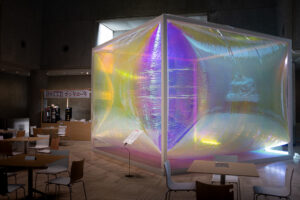
    As I continued my way down from the first exhibition hall, it was impossible to miss this colourful spectacle conspicuously located in the café area — a rainbow-coloured semi-transparent bubbly installation created by Okunaka Akihito titled INTER-WORLD / SPHERE: Over the Cube. It was awarded the Judges Prize by two members of the panel and, once again, it is not hard to understand why. This visually appealing piece commands attention. It looks like the perfect backdrop for an Instagram post, while its interactive nature invites visitors to step into the installation, immersing themselves upon a water bed while gazing at shifting reflections. An overview: the work intends to explore the dynamic relationship between humans and objects, aiming to evoke a sensory experience beyond the physical, whilst encouraging viewers to question present reality in the Anthropocene era. By using air, water, and light as materials, the installation symbolises our deep connection to these elements, prompting reflection on the trajectory of our reality, diversity, and the fragility of the environment.

    Very ambitious, perhaps a little too ambitious.

    A tad far-fetched, there lies a certain disparity between the realised work and the initial concept. The metaphysical dynamism within the socio-philosophical framework that the artist hopes to investigate becomes somewhat diluted in its final manifestation. Although still intriguing, the work’s single-dimensionality may not fully embody the intricacies and philosophical foundations originally envisioned. From a production standpoint, I wonder whether the work might thrive better in an outdoor setting, embracing natural light and the surrounding greenery.


    Moving on to the final section of the exhibition, as stated in the previous chapter, most of the actions here do not simply take place inside the cube. Some of the works physically assume the form of the cube itself. Possibly my favourite piece among them all, was a massive Amazon carton cut in half and moulded into a cube lying sideways. The work is titled Online shopping, created by Jun Kitagawa, an Aichi-born artist. As visitors walk inside the box, they themselves become the merchandise, the shrink-wrapped object devoid of life, waiting to be unboxed. Light-hearted and playful, an exceedingly straightforward concept aiming to seize the spirit of our contemporary zeitgeist, what’s not to love?

    Overall, this year’s AAIC was a delightful and easily navigable event, incorporating a diverse range of art forms and -isms. It is also worth noting the age diversity among the artists, with the youngest born in 2006 and the eldest in 1955. This entails a wide array of artistic perspectives which, as an audience, is both a rare sight to witness and a definite plus. I mean, at the end of the day, realities differ between individuals, right?

    The theme of the award this year revolves around the concept of “reality”, an undeniably resonant outcome stemming from the pandemic. When I first read the curatorial statement, I was, without a shadow of a doubt, intrigued, even though it did leave with a few question marks. Primarily because, well, everyone’s reality varies, and I dare say the collective pandemic experience here in Japan vastly contrasts with that of the rest of the world. As a nation, Japanese citizens displayed an exceptional inclination to adhere to orders or, recommendations, issued by the high-ups. The requirement to wear masks, for instance, was readily embraced, partly due to the already ingrained habit for many, owing to the severity of pollen allergies and the social etiquette surrounding it, which, in many ways, made such compliance nothing short of admirable. And as far as I have seen and heard, Japan has not suffered to the same extent as many other places, nor was a serious lockdown ever truly imposed. Either way, in this post-pandemic era, it is beyond doubt that our way of life and mindset, as well as society as a whole, have undergone a drastic transformation, pushing our generation towards somewhere obscure.


  • Art Award IN THE CUBE 2023: Where Reality Goes? — Chapter 1 | Museum of Fine Arts Gifu

    Art Award IN THE CUBE 2023: Where Reality Goes? — Chapter 1 | Museum of Fine Arts Gifu

    29 May 2023


    Established in 2017 and adopting the format of a Triennale, the Art Award IN THE CUBE (AAIC) held its third edition in 2023 at the Museum of Fine Arts Gifu. Summing up, the AAIC presents an art exhibition showcasing a list of winning artists under one universal theme titled Real no Yukue / Where Reality Goes?, chosen by a panel of judges comprising artists, professors, critics, and directors. Notably, each newly created artwork sits inside a spacious cubic space measuring approximately 5m by 5m. This study is divided into two chapters, both complemented by a series of photographs documenting the exhibition.

    Ever since the Setouchi Triennale was first inaugurated in 2010 and proved to be a massive triumph for the regional administration. Adored by locals and international tourists alike, every other prefecture across the country has been galvanised and started following suit by initiating its own artistic event, be it an award, a festival, a Biennale, or a Triennale — just about anything that employs contemporary art as the medium for drawing crowds. In this context, AAIC can perhaps be seen as Gifu’s very own audacious endeavour to ride the potential of this cultural wave.

    Inevitably, any discussion revolving around the award must also delve into the charming realm of Gifu Prefecture. Renowned for its majestic mountains, lush woods, meandering rivers, and countless cultural heritage sites, Gifu has always been a staple magnet for visitors, especially for people living in Nagoya. From the main station, depending on where you would like to go, the train can take you almost anywhere across this vast prefecture. I personally find myself visiting this land more frequently than any other in Japan simply because it is so close and offers so much.

    Curiously enough, it was only last year, during the application phase, that I first became aware of AAIC’s existence, let alone of people or artists living outside Tokai. Even during my time at the exhibition, there were only a handful of visitors. This relatively limited fame is further evidenced by ChatGPT’s unfamiliarity with the award, which is somewhat of a shame. For, truth be told, what unfolded before my eyes this year was rather interesting — most of the works consisted of installations fusing spatial and experiential elements. Did I anticipate such things from Gifu, other than subjects related to nature and objects of crafts? Most certainly not.

    So, what does the AAIC have in its pocket to offer this year in addressing our reality?

    It is also worth mentioning that the size of the “cube” in this year’s AAIC finds its inspiration in the theme of the award’s inaugural edition, Shintai no Yukue (Whereabouts of the Body), which alludes to the legend suggesting that Buddha stood at a height of approximately 4.8m. In total, there were 14 works by 14 individual artists on display this time around, either exhibited within a cube or masquerading as a cube, each assigned a letter of the alphabet spanning three exhibition halls, providing relatively easy navigation and more direct engagement with the works compared with a typical Triennale experience.

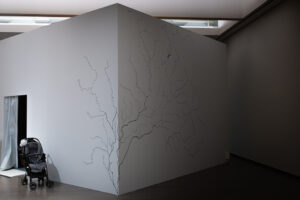
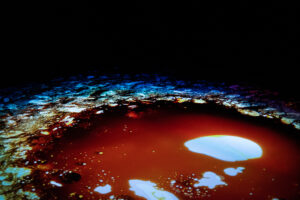
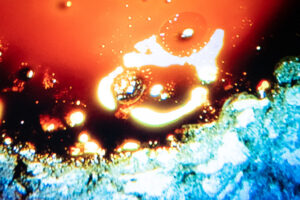
    Since every work was enclosed within the confines of individual cubes, I was able to make my way through the exhibition without the constraints of any particular order or sequence. Upon entering the first exhibition hall, my eyes were immediately locked onto a white cube adorned with intricate curly lines — a visual representation of an earth fissure, or so I presumed. And as it turned out, I was not too far off. The artwork residing within is called Melting Hida Mountains, created by Madoka Chiba, a Hokkaido-born artist. As you step into the darkened cube, a large video projection depicting what appears to be a volcanic crater stretches across the expanse of the floor. The ambient sounds of water dripping and rocks melting permeate the space, transporting viewers into the transformative process of rocks becoming molten magma. Every material used in the creation of this artwork was specifically procured from the lands and rivers of Gifu Prefecture. Considering the apparent abundance of active volcanoes in the area and the inherent seismic nature of Japan, by quite literally diving beneath the surface of the earth, the artwork invites viewers to contemplate the passage of time and the essence of the land beneath our feet, turning an elusive dimension into an immersive experience. Seemingly checking all the boxes, no surprise that it scooped the ¥5 million Grand Prize.

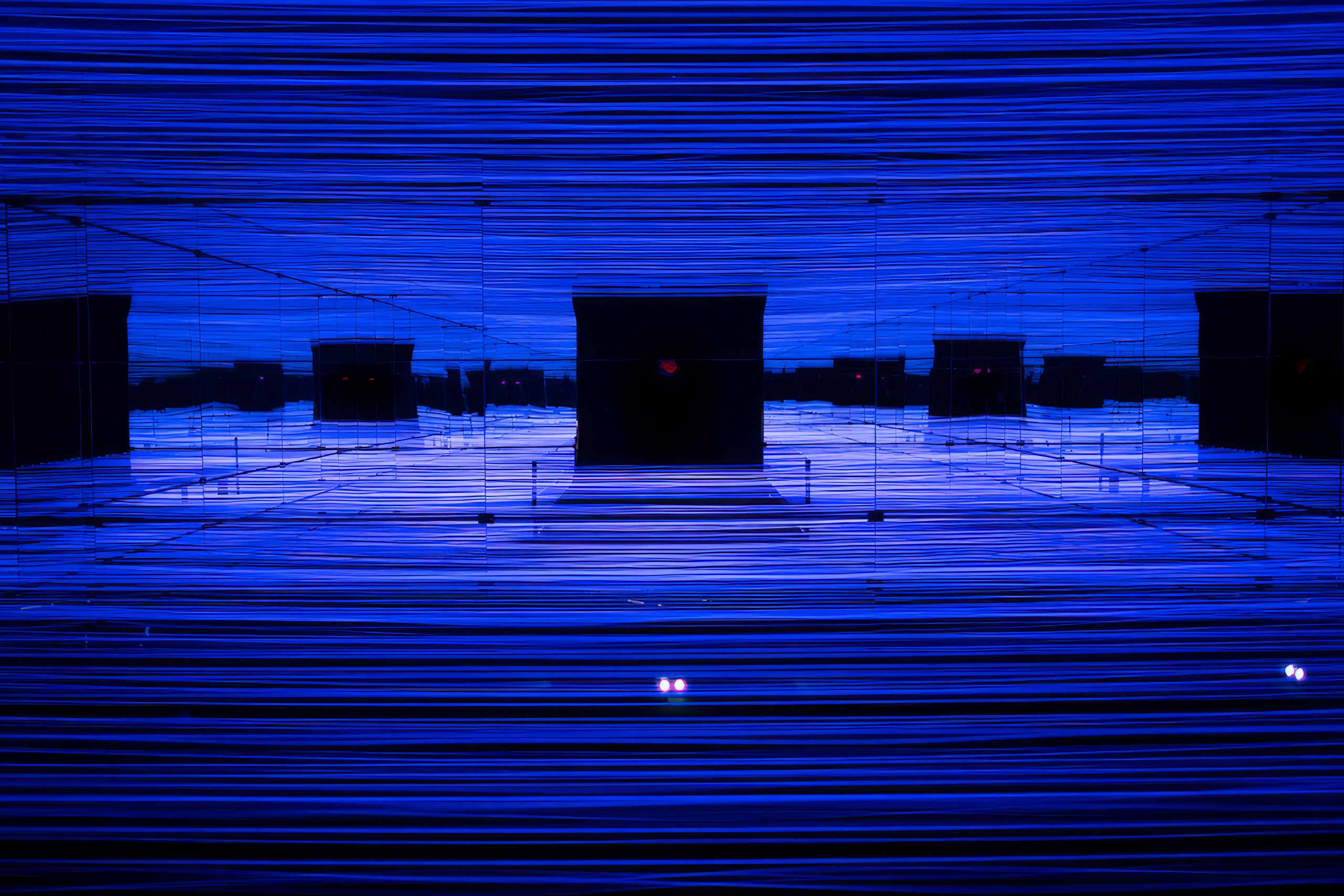
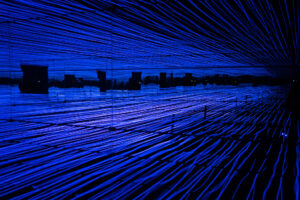
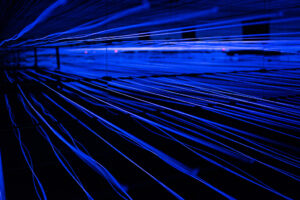
    Right across from it stood the cube hosting Afterreal 6, an installation work created by Yasuhiro Chida. Dominating the entire space, instantaneously the second you enter the cube, you are immersed in a world of innumerable threads, emitting a luminous blue shimmer under the ultraviolet light. The rapidly oscillating installation welcomes you into another reality. Essentially, what the lighting artist is trying to convey is that, what we see is not necessarily what exists, the images perceived by our eyes and processed by our brains do not exist in reality in the way we assume. Indeed, this installation effectively initiates the enquiry aligned with the overarching theme of the exhibition: reality itself. As human beings, we possess an innate propensity to ponder the significance behind every encounter our five senses perceive, in turn, questioning the purpose of art. More often than not, art serves no explicit function nor harbours definitive meanings. Yet Chida’s creation adeptly offers another gateway for the audience to momentarily transcend the harsh realities of life, perhaps revealing that this, in itself, is art’s true and only purpose.

    In the same hall, one would also find JK in the street by Momo Inagaki, where JK refers to a high school girl in Japanese. The artist, at the time of the exhibition, was only 17, i.e., a JK herself. Remarkable indeed, and being the youngest among them all, Inagaki’s choice of medium, as well as the concept of the work in its attempt to capture the “nowness” of an ordinary teenage girl’s reality, is conceivably the most straightforward, or should I say the most honest approach, among the exhibited works. Drawing inspiration from today’s video culture popularised by social media platforms, in this quasi-documentary film, the artist dissects and symbolically represents different aspects of her identity using a five-pointed star. Each tip of the star embodies a significant part of her “self”. Hold on — was I not conducting myself in a similar manner when I was around the same age? It somewhat reminded me of my own adolescence, when I too held onto a few things that I wholeheartedly believed defined, or entirely composed, me as a person. As time has passed, of course, none of those things remains relevant today. While I can imagine some might easily write off the work as superficial, its relatability makes it deeply resonant on a personal level. Inagaki’s work may also be seen as a visual manifestation of the Buddhist concept of ātma-grāha, signifying self-possession and self-control in one’s thoughts and actions, corresponding to the exhibition’s idea of the cube. The curatorial direction of the entire exhibition, in fact, mirrors numerous Buddhist philosophies. Without drifting off on too much of a tangent, however, this study will place greater focus on the artistic aspect rather than the teachings of Buddha…


    TO BE CONTINUED…

  • Okayama Art Summit 2022: Do We Dream Under the Same Sky — Chapter 1 | Former Uchisange Elementary School

    Okayama Art Summit 2022: Do We Dream Under the Same Sky — Chapter 1 | Former Uchisange Elementary School

    10 December 2022


    We would like to present to you a series of photographic essays centring on Okayama Art Summit 2022.

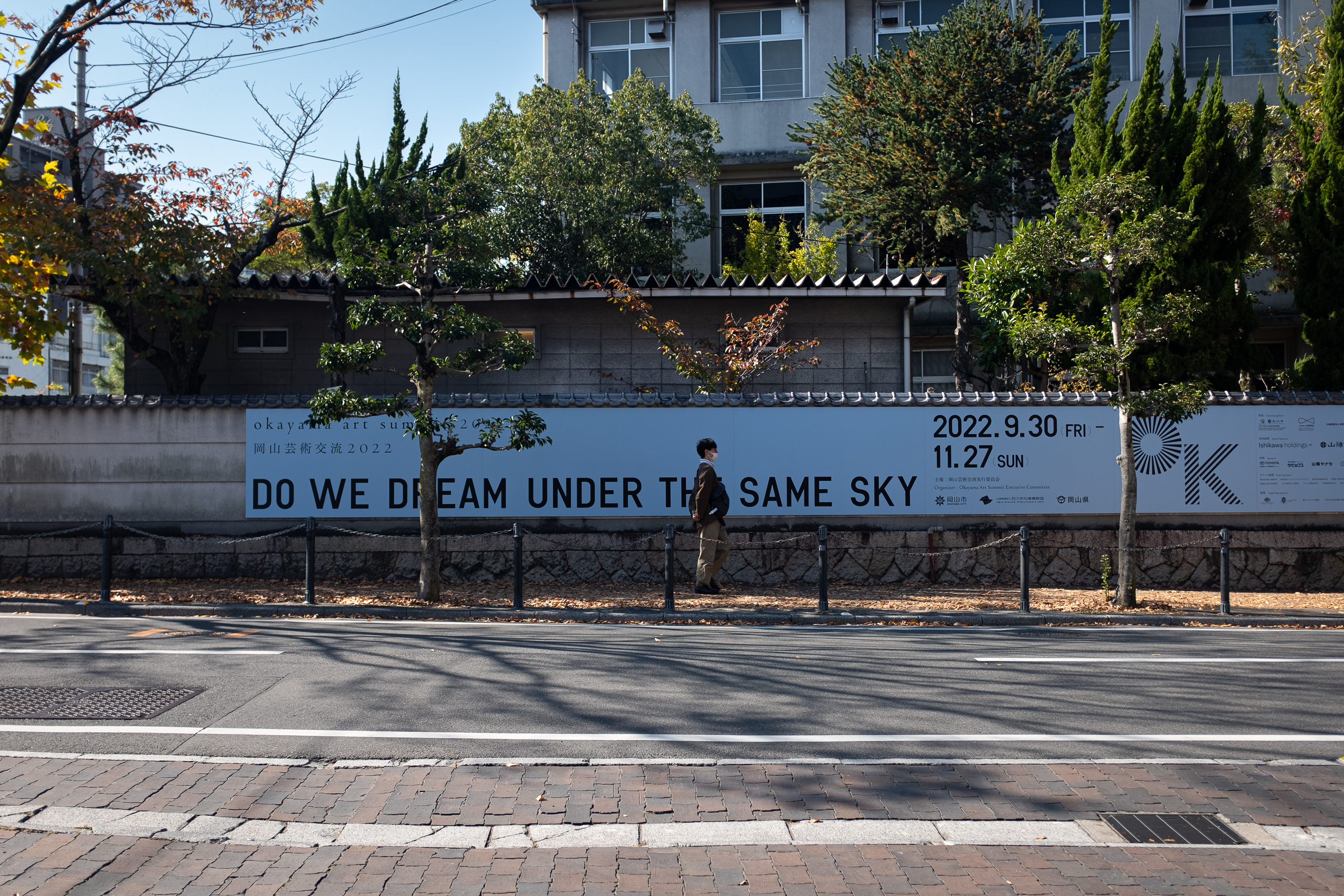
    Adhering to the format of a triennale, now running into its third edition, Okayama Art Summit 2022 was held from the 30th of September to the 27th of November, spearheaded by the artistic director Rirkrit Tiravanija1, who was born in Buenos Aires and is of Thai origin. Exhibitions spread throughout the city across a total of 10 different venues, including historical sites like Okayama Castle and Okayama Korakuen Garden (岡山後楽園), where the former is known as the “Crow Castle” due to its black exterior, and the latter is considered one of the top three Japanese gardens in the country. Having missed the previous edition in 2019, right after the conclusion of Aichi Triennale 2022 I set out on a journey towards Okayama, stopping by Marugame in Kagawa to sample some of the best udon that the place has to offer beforehand, a short train ride then took me right to the centre of where all the action was in the city of Okayama.

    Titled Do We Dream Under the Same Sky, the director posed a largely relevant and vital question amidst the post-pandemic political turmoil. Or rather, without the question mark towards the end of the title, it was more about the initiation of an idea, that regardless of nationality, race, gender or location, we do, in fact, all dream under the very same sky, in spite of the recent rise of nationalism and populism accelerated by the pandemic. This idea, prevails gracefully throughout the entirety of the Summit, where we come across a diverse range of 28 groups of artists from 13 countries.

    One interesting fact that may or may not elude the masses is that the hard-to-miss logo of the Summit was designed by Peter Saville, the world-famous Manchester-born graphic designer, who was also involved in the first edition of the Summit back in 2016. The logo reads “OK” and conspicuously refers to the city of Okayama. With the signages scattered across the entire city, it was almost as if the designer was responding to the proposal drafted by the Summit’s director: that everything will be affirmatively “okay”.

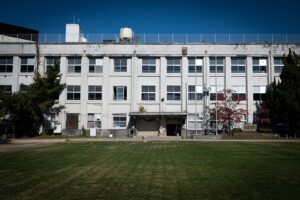
    The Summit is a private initiative produced by Yasuharu Ishikawa and directed by Taro Nasu, working with the local municipality in launching one of the most mesmerising art events in the country. In the first part of the photography series below, with the second part following in a separate post, we zoom in on one of the main exhibition venues: the former Uchisange Elementary School (旧内山下小学校). Highlights included the Kimura Ihei2 Award-winning photographer Mari Katayama3, whose work explores social prejudice by using her own body as the subject, presented here via the medium of large-scale photography as well as a spatial installation in one of the classrooms.

    In another classroom upstairs, Apichatpong Weerasethakul4 dwelt further on memory and time, blurring the lines between reality and fantasy. In an abandoned swimming pool near the school building lay a gigantic curious toy bear on its back, staring at the sky. Created by Precious Okoyomon5, titled Touching My Lil Tail Till the Sun Notices Me, the innocent-looking stuffed bear was dressed in lace underwear. Perhaps inspired by, or troubled by, the ubiquitous “kawaii culture” in Japan, where infantilisation often sparks complaints and criticism from the West, the artist painted a pronounced contrast between cuteness and perversity. In a further corner of the open field playground outside the school buildings stood an all-white installation resembling an inverted umbrella, its light, skeletal form recalling the architectural vocabulary of Sou Fujimoto6. Designated as a smoking area, it lent an unexpected sense of occasion to the otherwise mundane act of smoking, which is indeed a rare indulgence, politically correct or not.

    In two additional parts of the series covering the rest of the areas, at Okayama Tenmaya (天満屋), more works by Mari Katayama were exhibited. As passersby walked past, many didn’t even bat an eyelid. The works were surprisingly, or rather unsurprisingly, easy to miss. Masquerading impeccably as shop window displays, titled just one of those things, the high heels project launched by the artist back in 2011, further questioned the idea of beauty in Japan and the status of Japanese female company workers, many of whom are expected to wear high heels, conforming to social standards in a male-dominated society.

    In Cinema Clair Marunouchi, more works by the Thai artist Apichatpong Weerasethakul were showcased. Several of the artist’s video works were pieced together, to compose a 90-minute film. A highly regarded filmmaker by critics and a popular choice among curators of art events. The themes in his works often involve the exploration of memories and desires, converging at the intersections of the spiritual, natural and political worlds. The director’s works are often slow, unfolding at a rather contemplative pace. There were quite a few viewers who dozed off while the film was screening, which was understandable, fair to say, if you weren’t already familiar with Weerasethakul’s work, or walked in expecting a Marvel production. After several encounters with the artist’s video works in various places across the world myself, there’s always that WTF moment. I personally was never really sure if I had wasted hours of my life trying to dissect the work, hopelessly wishing to make sense of everything I saw, or whether I had witnessed something so damn extraordinary that my tiny human brain couldn’t even grasp it. So yes, if you’ve ever fallen asleep during one of Weerasethakul’s films, I share that sentiment, and I’m sure you weren’t the first and won’t be the last.

    Another delightful find was the work created by Enkū (円空), the Buddhist monk, exhibited in the Okayama Orient Museum. Born in 1632 and dying in 1695 in what is now Gifu Prefecture, Enkū’s sculptures stand out from more traditional Buddhist statues by embracing a, for lack of a better word, contemporary approach that showcases the natural beauty of the materials. When exhibited at a contemporary art event, Enkū’s work subtly weaves an intriguing narrative that bridges the past and present. His Buddha sculptures, characterised by their rough, textured surfaces and imperfect forms, are highly expressive and convey a sense of warmth and compassion that is central to Buddhist practice. Personally, I believe that the director’s intention was to deliver a message that transcends time. By placing ourselves within the course and tides of history, human beings have always lived under the exact same sky. Warmth and compassion, isn’t that what the world needs right now?

    In another special chapter in this series, which aims to capture glimpses of Okayama City after night falls, it offers an alternative perspective to the Summit, whose activity is largely concentrated during the day.