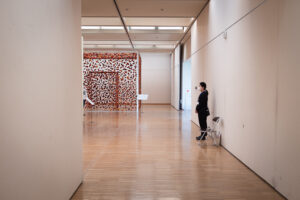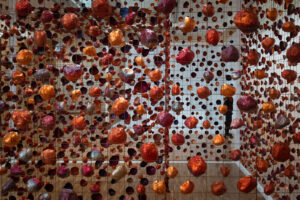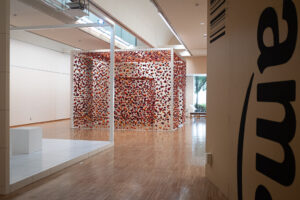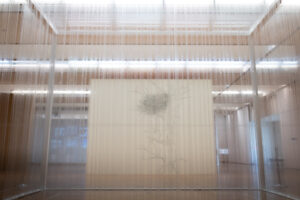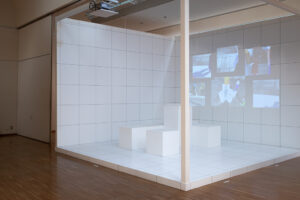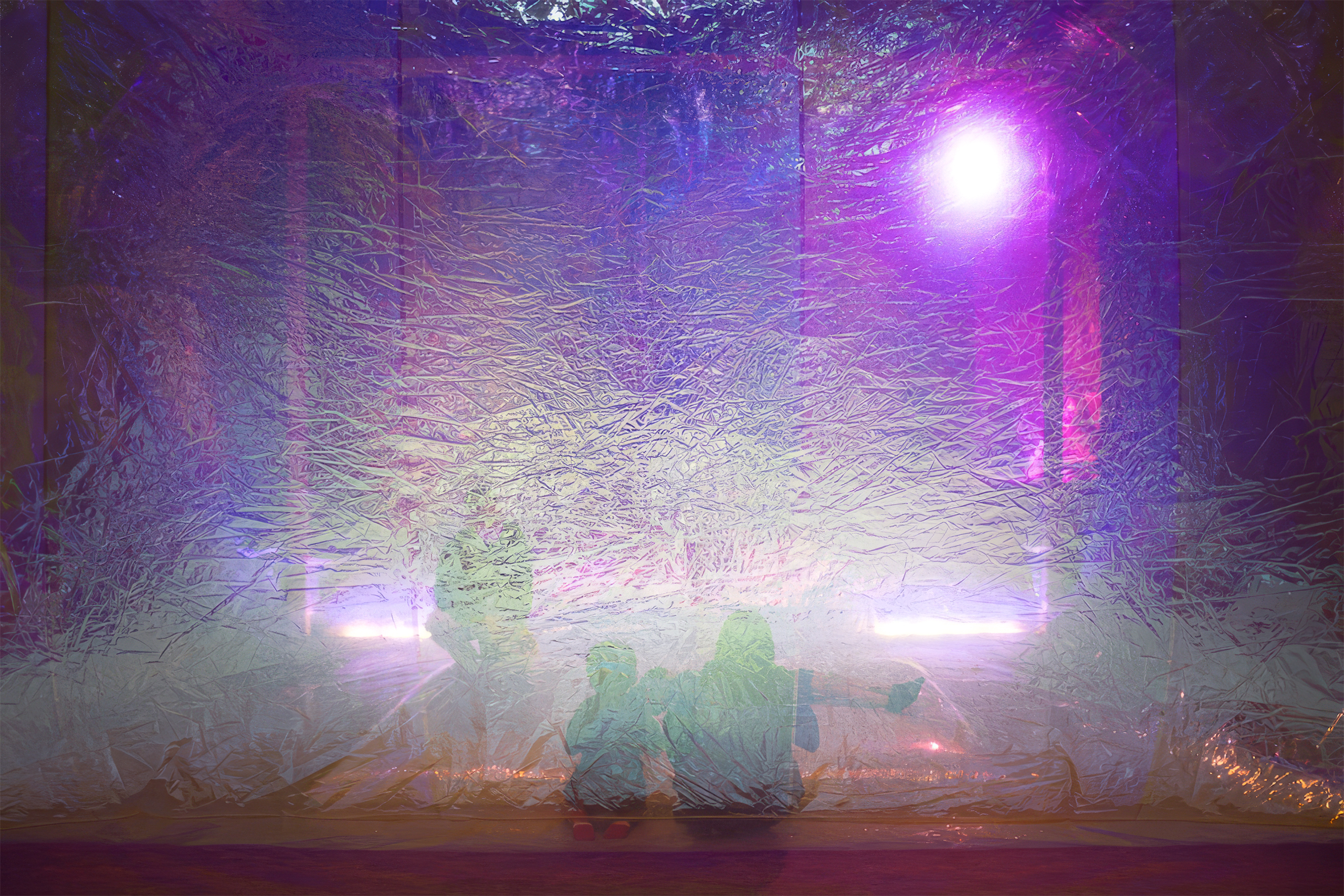
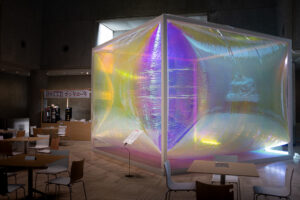
As I continued my way down from the first exhibition hall, it was impossible to miss this colourful spectacle conspicuously located in the café area — a rainbow-coloured semi-transparent bubbly installation created by Okunaka Akihito titled INTER-WORLD / SPHERE: Over the Cube. It was awarded the Judges Prize by two members of the panel and, once again, it is not hard to understand why. This visually appealing piece commands attention. It looks like the perfect backdrop for an Instagram post, while its interactive nature invites visitors to step into the installation, immersing themselves upon a water bed while gazing at shifting reflections. An overview: the work intends to explore the dynamic relationship between humans and objects, aiming to evoke a sensory experience beyond the physical, whilst encouraging viewers to question present reality in the Anthropocene era. By using air, water, and light as materials, the installation symbolises our deep connection to these elements, prompting reflection on the trajectory of our reality, diversity, and the fragility of the environment.
Very ambitious, perhaps a little too ambitious.
A tad far-fetched, there lies a certain disparity between the realised work and the initial concept. The metaphysical dynamism within the socio-philosophical framework that the artist hopes to investigate becomes somewhat diluted in its final manifestation. Although still intriguing, the work’s single-dimensionality may not fully embody the intricacies and philosophical foundations originally envisioned. From a production standpoint, I wonder whether the work might thrive better in an outdoor setting, embracing natural light and the surrounding greenery.
Moving on to the final section of the exhibition, as stated in the previous chapter, most of the actions here do not simply take place inside the cube. Some of the works physically assume the form of the cube itself. Possibly my favourite piece among them all, was a massive Amazon carton cut in half and moulded into a cube lying sideways. The work is titled Online shopping, created by Jun Kitagawa, an Aichi-born artist. As visitors walk inside the box, they themselves become the merchandise, the shrink-wrapped object devoid of life, waiting to be unboxed. Light-hearted and playful, an exceedingly straightforward concept aiming to seize the spirit of our contemporary zeitgeist, what’s not to love?
Overall, this year’s AAIC was a delightful and easily navigable event, incorporating a diverse range of art forms and -isms. It is also worth noting the age diversity among the artists, with the youngest born in 2006 and the eldest in 1955. This entails a wide array of artistic perspectives which, as an audience, is both a rare sight to witness and a definite plus. I mean, at the end of the day, realities differ between individuals, right?
The theme of the award this year revolves around the concept of “reality”, an undeniably resonant outcome stemming from the pandemic. When I first read the curatorial statement, I was, without a shadow of a doubt, intrigued, even though it did leave with a few question marks. Primarily because, well, everyone’s reality varies, and I dare say the collective pandemic experience here in Japan vastly contrasts with that of the rest of the world. As a nation, Japanese citizens displayed an exceptional inclination to adhere to orders or, recommendations, issued by the high-ups. The requirement to wear masks, for instance, was readily embraced, partly due to the already ingrained habit for many, owing to the severity of pollen allergies and the social etiquette surrounding it, which, in many ways, made such compliance nothing short of admirable. And as far as I have seen and heard, Japan has not suffered to the same extent as many other places, nor was a serious lockdown ever truly imposed. Either way, in this post-pandemic era, it is beyond doubt that our way of life and mindset, as well as society as a whole, have undergone a drastic transformation, pushing our generation towards somewhere obscure.