29 May 2023
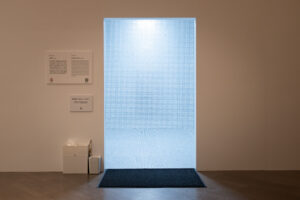
Established in 2017 and adopting the format of a Triennale, the Art Award IN THE CUBE (AAIC) held its third edition in 2023 at the Museum of Fine Arts Gifu. Summing up, the AAIC presents an art exhibition showcasing a list of winning artists under one universal theme titled Real no Yukue / Where Reality Goes?, chosen by a panel of judges comprising artists, professors, critics, and directors. Notably, each newly created artwork sits inside a spacious cubic space measuring approximately 5m by 5m. This study is divided into two chapters, both complemented by a series of photographs documenting the exhibition.
Ever since the Setouchi Triennale was first inaugurated in 2010 and proved to be a massive triumph for the regional administration. Adored by locals and international tourists alike, every other prefecture across the country has been galvanised and started following suit by initiating its own artistic event, be it an award, a festival, a Biennale, or a Triennale — just about anything that employs contemporary art as the medium for drawing crowds. In this context, AAIC can perhaps be seen as Gifu’s very own audacious endeavour to ride the potential of this cultural wave.
Inevitably, any discussion revolving around the award must also delve into the charming realm of Gifu Prefecture. Renowned for its majestic mountains, lush woods, meandering rivers, and countless cultural heritage sites, Gifu has always been a staple magnet for visitors, especially for people living in Nagoya. From the main station, depending on where you would like to go, the train can take you almost anywhere across this vast prefecture. I personally find myself visiting this land more frequently than any other in Japan simply because it is so close and offers so much.
Curiously enough, it was only last year, during the application phase, that I first became aware of AAIC’s existence, let alone of people or artists living outside Tokai. Even during my time at the exhibition, there were only a handful of visitors. This relatively limited fame is further evidenced by ChatGPT’s unfamiliarity with the award, which is somewhat of a shame. For, truth be told, what unfolded before my eyes this year was rather interesting — most of the works consisted of installations fusing spatial and experiential elements. Did I anticipate such things from Gifu, other than subjects related to nature and objects of crafts? Most certainly not.
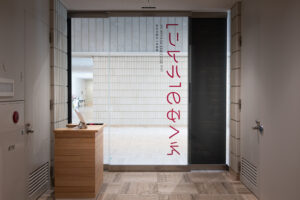
So, what does the AAIC have in its pocket to offer this year in addressing our reality?
It is also worth mentioning that the size of the “cube” in this year’s AAIC finds its inspiration in the theme of the award’s inaugural edition, Shintai no Yukue (Whereabouts of the Body), which alludes to the legend suggesting that Buddha stood at a height of approximately 4.8m. In total, there were 14 works by 14 individual artists on display this time around, either exhibited within a cube or masquerading as a cube, each assigned a letter of the alphabet spanning three exhibition halls, providing relatively easy navigation and more direct engagement with the works compared with a typical Triennale experience.
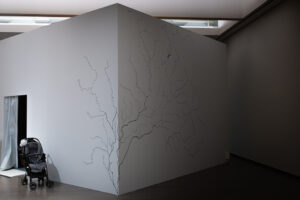
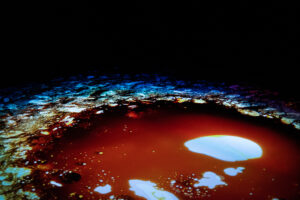
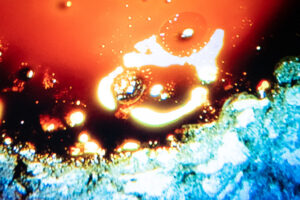
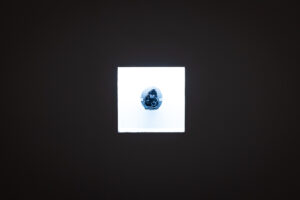
Since every work was enclosed within the confines of individual cubes, I was able to make my way through the exhibition without the constraints of any particular order or sequence. Upon entering the first exhibition hall, my eyes were immediately locked onto a white cube adorned with intricate curly lines — a visual representation of an earth fissure, or so I presumed. And as it turned out, I was not too far off. The artwork residing within is called Melting Hida Mountains, created by Madoka Chiba, a Hokkaido-born artist. As you step into the darkened cube, a large video projection depicting what appears to be a volcanic crater stretches across the expanse of the floor. The ambient sounds of water dripping and rocks melting permeate the space, transporting viewers into the transformative process of rocks becoming molten magma. Every material used in the creation of this artwork was specifically procured from the lands and rivers of Gifu Prefecture. Considering the apparent abundance of active volcanoes in the area and the inherent seismic nature of Japan, by quite literally diving beneath the surface of the earth, the artwork invites viewers to contemplate the passage of time and the essence of the land beneath our feet, turning an elusive dimension into an immersive experience. Seemingly checking all the boxes, no surprise that it scooped the ¥5 million Grand Prize.
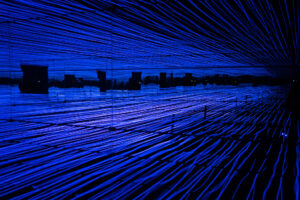
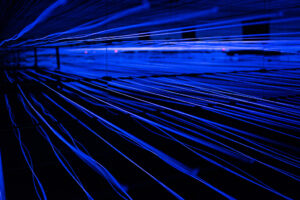
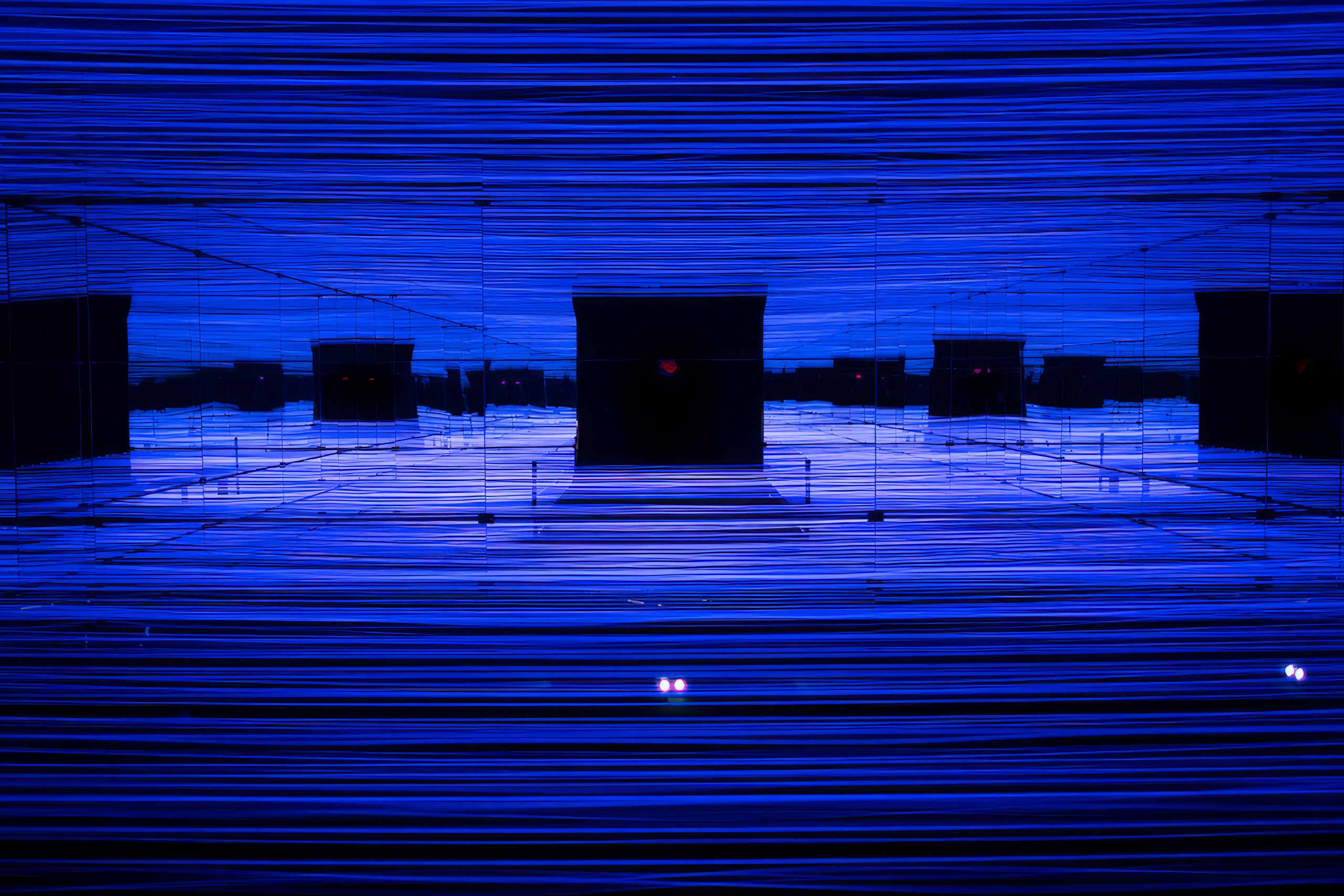
Right across from it stood the cube hosting Afterreal 6, an installation work created by Yasuhiro Chida. Dominating the entire space, instantaneously the second you enter the cube, you are immersed in a world of innumerable threads, emitting a luminous blue shimmer under the ultraviolet light. The rapidly oscillating installation welcomes you into another reality. Essentially, what the lighting artist is trying to convey is that, what we see is not necessarily what exists, the images perceived by our eyes and processed by our brains do not exist in reality in the way we assume. Indeed, this installation effectively initiates the enquiry aligned with the overarching theme of the exhibition: reality itself. As human beings, we possess an innate propensity to ponder the significance behind every encounter our five senses perceive, in turn, questioning the purpose of art. More often than not, art serves no explicit function nor harbours definitive meanings. Yet Chida’s creation adeptly offers another gateway for the audience to momentarily transcend the harsh realities of life, perhaps revealing that this, in itself, is art’s true and only purpose.
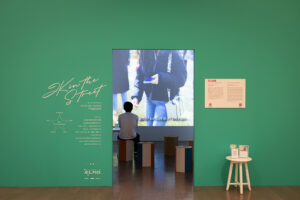
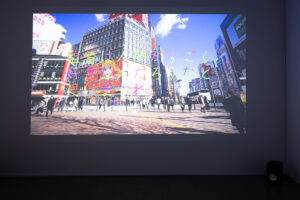
In the same hall, one would also find JK in the street by Momo Inagaki, where JK refers to a high school girl in Japanese. The artist, at the time of the exhibition, was only 17, i.e., a JK herself. Remarkable indeed, and being the youngest among them all, Inagaki’s choice of medium, as well as the concept of the work in its attempt to capture the “nowness” of an ordinary teenage girl’s reality, is conceivably the most straightforward, or should I say the most honest approach, among the exhibited works. Drawing inspiration from today’s video culture popularised by social media platforms, in this quasi-documentary film, the artist dissects and symbolically represents different aspects of her identity using a five-pointed star. Each tip of the star embodies a significant part of her “self”. Hold on — was I not conducting myself in a similar manner when I was around the same age? It somewhat reminded me of my own adolescence, when I too held onto a few things that I wholeheartedly believed defined, or entirely composed, me as a person. As time has passed, of course, none of those things remains relevant today. While I can imagine some might easily write off the work as superficial, its relatability makes it deeply resonant on a personal level. Inagaki’s work may also be seen as a visual manifestation of the Buddhist concept of ātma-grāha, signifying self-possession and self-control in one’s thoughts and actions, corresponding to the exhibition’s idea of the cube. The curatorial direction of the entire exhibition, in fact, mirrors numerous Buddhist philosophies. Without drifting off on too much of a tangent, however, this study will place greater focus on the artistic aspect rather than the teachings of Buddha…