To begin, we must first address how one engages with an artwork, contemporary art especially. Primarily we engage by looking, and yet looking is never neutral. As John Berger famously wrote, “We never look at just one thing; we are always looking at the relation between things and ourselves.”1 Berger would say that we never encounter an artwork in isolation, it exists within a dense web of culture, memory, and even ideology. The artwork is not merely an object sitting in front of our eyes, this encounter itself is shaped by power, context, and our own position as viewers.
But today.
Our encounter with art is now almost, always mediated by smartphones, through the phone camera’s lens, its aestheticising filters, and the unseen algorithms that sit quietly in the background like a dark, invisible mediator governing what is allowed to surface and what slips into obscurity. Berger once noted that mechanical reproduction dramatically reframes an artwork’s meaning, his logic extends naturally further in a similar vein, such that today, each smartphone image becomes a new iteration of the original work, an edited version that’s instantly shareable. Perhaps less a reproduction than a mutation with every capture, entering a stream of images in circulation competing for attention, rather than contemplation.


As these mutations travel — and they travel fast — a bit like COVID, they behave less like representations of originals but more like signals, quickly absorbed, and quickly replaced. You don’t linger over them, not only because your attention span is already fucked but, what’s there to linger on? Meanings have multiplied tenfold, not by deepening but by spreading, the authority of any “original” meaning is essentially destabilised if not, completely destroyed and erased (James Bridle, 2014)2.
Art, has gone full-on mobile.
In 2014, critic Matt Trueman wrote that “screens have replaced the page and the stage,”3 and he’s spot-on, even more so nearly a decade later. For many of us, be it curator or artist, collector or spectator, we now meet artworks on our screens first, well ahead of any physical interaction in person, if that ever happens at all, the image eclipses both the object and the experience.
I recall a conversation I had some years ago with Jinhui Wang, a London-based digital artist born in 1997, who said that for her generation, the use of a computer mouse had become second nature, it’s like an extension of the arm itself. The smartphone nowadays plays a comparable and more intimate role, we’re so utterly accustomed to encountering art through devices that we expect nothing less, and nothing more — art must come to me and not me going to it. Our viewing and aesthetic interactions are compressed into and redirected toward the scope of a screen, such that, “experiencing art through it feels as natural as any other interface”4, as Trueman rightly suggested.
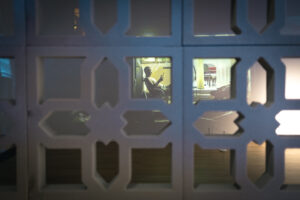
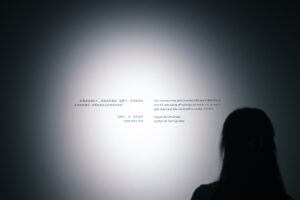

So how do we engage with art in today’s world? I think by now the answer is uncomfortably but blatantly obvious: we see via our screens, and we engage by photographing them. Berger’s insight — that we never look at just one thing — has acquired a new dimension. Through the framing device of a phone, we now look at the relationship between objects and ourselves, alongside the networked audience we carry on this phone in our pockets, which in turn, frames not only what we see, but how we expect others to see us seeing it.
Albeit slightly wordy, the point is fairly simple: the act of looking is no longer a private one; an element of anticipation and performance is unequivocally attached to it. We don’t see, nor consume for ourselves anymore, we do so for an imagined viewership on social media and beyond, and ultimately, this changes how we look at art. The question subtly slides from the self-introspective, “What does this piece of art mean to me?” to the self-narcissistic, “ How does this art reflect on my feed?” The very conditions under which contemporary art is seen and understood, and through which it circulates, are being redrawn, the coordinates no longer hold on the map.
You know when you’re physically ill, and your mind seems to race faster, as your body’s stress rises and the immune system acts up, particularly when the senses are overloaded? Let’s take a breather, shall we?