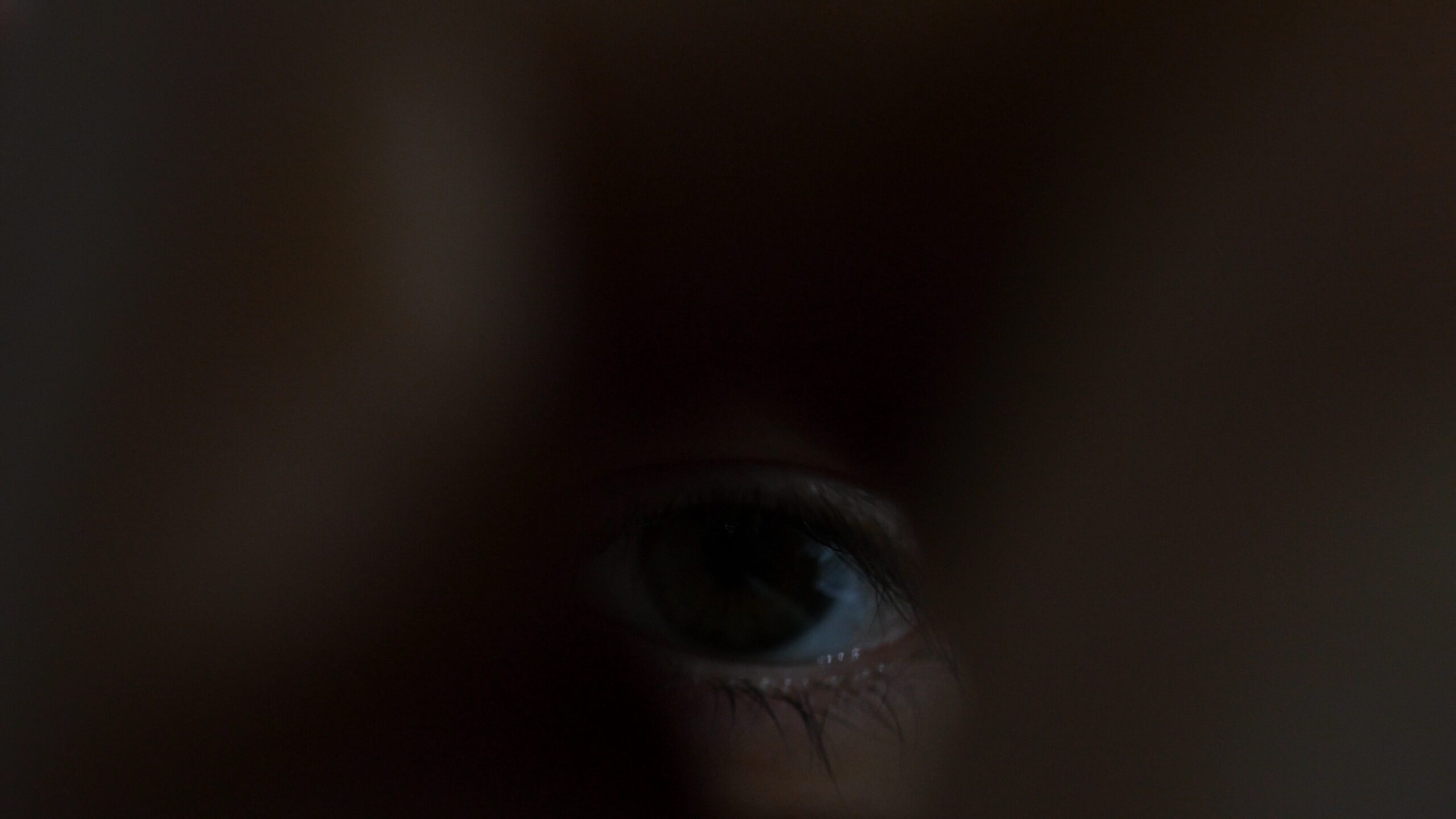
The first thing that caught the eyes, was this slightly distorted figure, alien-like, which almost immediately reminded me of the unsettling and visceral works by Francis Bacon, the British painter.
The surname of the artist behind those works, “Nemeth”, certainly piqued my interest. For anyone who doesn’t share any enthusiasm for fashion, hell, even if you are an expert in the subject matter, chances are the name might still elude you. It wasn’t your mainstream luxury brand known to every household, nor was it one of the Belgian or Japanese designer names we used to consider “niche”. It was probably around the time I was first exposed to Dover Street Market in London, where the works of Christopher Nemeth were sitting on the third floor, if memory serves me right, along with the likes of highly sought-after Elena Dawson and others. It was one of those early retail experiences I would never forget — discovering genuine designer garments that boasted meticulous craftsmanship and intricate details, all in the flesh.
Around the summer of 2021, I eventually managed to overcome my initial fear of rejection, and reached out to Riyo Nemeth (ネメス・リヨ), the artist, who turns out to be Nemeth’s daughter, for a potential collaboration. Following a series of emails and Zoom meetings over the course of more than 12 months, we finally, finally caught up with each other in Tokyo when all the pandemic restrictions were lifted in Japan.
Near Shibuya, in a vibrant izakaya with rock music blasting, I met Riyo face-to-face for the first time in December 2022. What struck me the most was how much she reminded me of the UK — London, to be precise — a place I had called home for almost twenty years, before the outbreak, which had kept me away from the English capital for more than four years and counting. Fair to say, it was quite some sense of nostalgia, even though I had only just met this person for the first time in real life.
Slender and tall, somewhat ghostly and enigmatic at first sight, dressed head-to-toe black, very likely all Nemeth too, edged with a hint of Comme des Garçons. Albeit slightly shy and introverted, perhaps even a little timid, yet at the same time stoic, extremely poised. Had I encountered her by chance in an East London pub, I wouldn’t have thought twice about her being a native of Tokyo. In fact, I wouldn’t have been surprised if it turned out we had unknowingly passed each other on the streets of Shoreditch at some point in our respective past.
Looking back now, and thinking about it all, was it truly Dover Street Market where I first stumbled upon the namesake label of Riyo’s father, I couldn’t tell. As we age, our memories fade, and I can no longer keep up with the tricks they play. What captivated me about Riyo’s work was exactly this, the way she delves deep into the fabric of our memories and creates this surreal sense of unfamiliarity by capturing the essential sights of our familiar surroundings and objects, exquisitely exploring the delicate line blurring reality and imagination.
We completed the following interview in early 2023, with our first session initially beginning in August 2022. In this interview, Riyo talked about her past, the work that she’s doing right now, as well as her artistic practise.
AXEL WANG:
Riyo, how did you end up with a Fine Arts degree from Central Saint Martins? Given your background, one would probably imagine you doing something slightly more related to the spectrum of fashion. Why did you choose to do art? Was there any family influence?
RIYO NEMETH:
At the time, I wasn’t completely sure what path to take, but I chose Fine Art because I believed that art is at the core of all creation, and that learning the process of making art can be applied to any kind of field. My father studied Fine Art, and this was what he told me. He did become a fashion designer, even so, he continued painting, which was something he was truly passionate about.
I always loved art, as well as fashion and music. Like a lot of people, I was fascinated by music videos and fashion magazines growing up, and from there I became curious about the process of artistic visualisation and interpretation across other fields like music and fashion. From a young age, I was often taken to a space called SuperDeluxe in Roppongi, which was run by friends of my parents, and I used to watch live music and video performances there quite frequently. Now looking back, I think the experiences I had there were the reasons why I was unconsciously drawn to video art and why I continue to pursue it.
AW: Why did you decide to go to London for your university studies?
RN: I was born and raised in Tokyo, and my father is British, but we rarely went to England when I was young. I think I simply wanted to know more about the other side of my nationality.
AW: And the obvious question that follows, when and why did you decide to come back to Tokyo?
RN: I came back to Tokyo to help my family business when I was 25.
AW: How would you compare the two places, in terms of working and everyday living?
RN: It’s hard to compare because I was a student, then a graduate, when I was in London. I have the fondest memories of being in my early 20s, which was the best time to be there in London. The city was inspiring, and still is for me. I found that the manner in which individuals share their viewpoints, articulate their concepts, and how they engage in the creative processes is more straightforward. While Tokyo is my hometown, where I feel extremely at ease, the creative process here appears to be more indirect compared to London.
Having experienced both cities, I believe I have been influenced by their respective approaches. Plus, over here, I have easier and cheaper access to all sorts of materials and equipment. I’ve been able to make works here that would’ve been extremely hard to execute in London. So personally, London is a good place to absorb ideas, and Tokyo is a good place to materialise some of these ideas.
AW: Japan is generally considered a homogeneous society. There are many “hafu1” stories out there that recount discomfort stemming from differences in skin colour, facial features, or even accent. What was it like for you growing up in Japan? Did you ever struggle with your identity?
RN: As a child, I attended Japanese schools, and I could only speak Japanese. My parents made a conscious decision to raise me with a singular racial identity. I felt like just another kid — I never really thought about my slightly different appearance. I’m lucky that I don’t have any bad memories of being directly or indirectly discriminated against, though I didn’t have much knowledge about racial discrimination at the time. When you don’t know, you don’t see it right? There were probably a bunch of small things, I just wasn’t aware of them, or have since erased them from my memory.
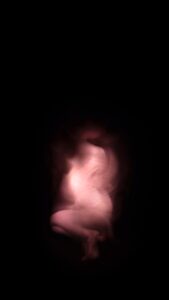
AW: At first glance, your work would perhaps strike one as haunting. The images are obviously very dark, and there’s an air of enigmatic mystery to them. They reminded me of Deborah Turbeville and Francesca Woodman, and also Francis Bacon and Georg Baselitz, to a certain degree. Let’s talk about your inspirations, which I understand can be a bit nonsensical, yet they have to be brought up when interviewing with an artist. I guess that’s just an easier way for people to draw correlations between what they know and what they don’t. Is there an artist or figure that you resonate with, or who has inspired you the most?
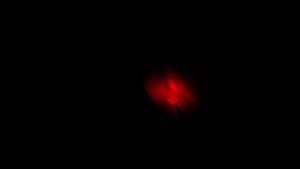
RN: Many of my video works feature a black background, which I view as equivalent to a white canvas, but on a screen. I like to think that my process of creating video works is somewhat similar to painting texture by adding layers of images.
Francis Bacon is one of my favourite artists. I’m fascinated by his ability to deform human bodies to the extent of being almost unsettling while still retaining a sense of familiarity. I love the texture and shadow in his work — it feels as though they have absorbed time itself. I’m also a great admirer of Bill Viola, whose image-making and immersive installation works are something I’ve always looked up to. And Michael Snow’s ability to manipulate images and create a sense of spacious consciousness has left a lasting impression on me since the beginning of my creative career.

AW: Riyo, your work engages with the passing of time, would you say that you are a nostalgic person?
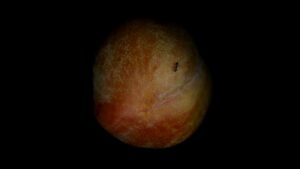
RN: You could say that. Talking about nostalgia, memory is something that I often think about when making work. The memory of familiar surroundings that we share, and how that affects the way we see things. For example, when you see an apple, you know the texture and weight, even if it’s projected larger than yourself, you know the feeling of holding it in your hand. So I often try to manipulate our common recognition, or even exaggerate it, to create unfamiliarity within familiar perspectives.
I also think time can not only bring more reality to an image, but disturb it simultaneously. People unknowingly assume how things move, and by seeing movement, we perceive the subject’s weight and size. I like changing the speed of movement to create uncertainty. When I make videos, I try to visualise the density and weight of time by altering the speed or sound, using layers of photographs, and in the process, I think about how many frames per second to add in order to create depth in movement, as well as in time.
AW: What is it about the medium that fascinates you so much? Or perhaps, a more romantic way of asking this question would be, did you choose the medium or did the medium choose you?
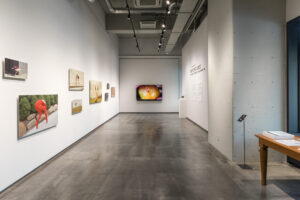
RN: I like the light, sound and impact that video possesses, that’s what I’m purely drawn to, plus the depth of time which I have in total control to disperse or condense. When I first started working with video in my work, it was more of an instinctive decision. I’m terrible at painting or drawing, but with video, it feels freer. Nevertheless, I admire the process of painting — how you can start from a blank canvas and create an infinite imagination. Whereas with video and photography, you usually need to provide a subject to capture. Although technology imposes certain limitations, at the same time, there are countless possibilities, and how it challenges me to turn the shooting subject into my complete creation is what captivates me too.
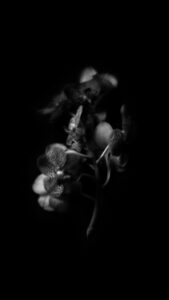
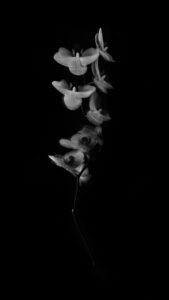
AW: I remember watching this performance by TAO Dance Theater2 at Sadler’s Wells in London back in 2014. I was completely baffled by the repetitive choreography at the beginning, it just wasn’t like any contemporary dance you’d come to expect. After a while, I started to realise something different, repetition, isn’t it kind of like what life is really all about? We follow the same routines, day by day, year by year, the cycle continues, and we try to find meanings among all these repetitions, these cycles. During the performance, underneath the repetition, you saw the limits imposed by the human body, and you saw discipline, there was a balance of restraint and abandon, and yet you sensed a desire to break out of the repetition.You sensed an emergence of chaos, it’s almost like an abstract expressionist’s painting. Riyo, your work to me feels a little bit similar, in the way that you use repetition and infinite looping, that they can feel palpable even, what does repetition mean to you?
RN: Repetition is one of the aspects that I’ve been experimenting with in my work. I’m intrigued by the limitations and possibilities of the medium I work with, and how video has the power to transition between the real and the unreal.
As we live in repetitive daily routines, the same goes for dance, our bodies repeat the same movement over and over again, and there are numerous overlapping cycles of different scales in our lives. However, each time, it’s never quite the same movement. On the other hand, in a video, you can repeat the exact same movement, yet it becomes unnatural. I like experimenting with how we unintentionally ignore aspects of certain things, to see what we want to see, and how quickly we notice uncertainties.
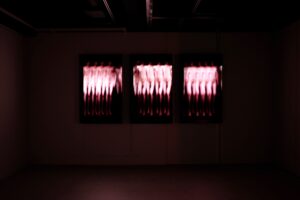
Technically, videos cannot be repeated infinitely as they essentially run on electricity to be materialised. At the end of the day, someone has to connect the media and switch it on, otherwise it cannot exist. In that sense, digital works are more unsustainable than paintings, comparatively and technically, they, in fact, decay much faster. I’ve been thinking about this underlying contradiction in my work, and I see similarities with some aspects of our lives, as we live through the repetitive daily routine, and we tend to forget that things don’t last forever.
AW: We can’t really avoid bringing up the pandemic. How was that whole thing for you?
RN: It feels like the last three years crept by so slowly, yet the memories feel few and far between. I was scared and frustrated at the beginning of the pandemic, uncertain about what tomorrow or the future would bring. The constant barrage of news reports during that time obviously had a significant impact on me, it felt like the world was shifting and changing at an unprecedented rate. But amidst it all, it was incredible to see how the entire world shared this collective experience. It was surreal that someone halfway across the globe could relate to my fears and concerns.
AW: Referencing Georg Baselitz once more, who said that good art should come from misery. During the pandemic, societal changes aside, I felt that some riveting ideas were being thrown around and emerged, be it meaningful or not, like NFTs for instance. Do you agree with what Baselitz said?
RN: I like that idea, I think misery is, in some way, unpleasant but strangely alluring, and we still haven’t quite grasped it fully yet. People look for change when they are desperate for change. After experiencing misery, you are forced to move forward and seek out something new. Restriction may spark new ideas, even if they stem from misery and discomfort. Isolation slows you down or stops you completely, forcing you to look around yourself more deeply and more elaborately, like seeing through a macro lens, and you might just find something you were too busy to notice before.
AW: Is there any other medium you are looking to explore in the future?
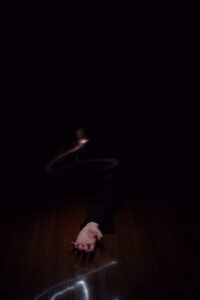
RN: I’m always interested in performance, so I definitely would like to incorporate some performative live elements into video works in the future, where videos and people intersect within a space, every time the video repeats itself, it would be slightly different, changing. I tend to make videos in a very precise way, which is why I want to inject more rawness and unpredictability that performance brings to the table — where each repetition of a person’s movement can be unique.
Video has been, and will continue to be my primary medium, though I also incorporate photographs into my videos. My aim is to integrate video, photography, and live performance into a single creative process, resulting in a more immersive experience that seamlessly transitions between two-dimensional and three-dimensional forms. In this context, I am keen to delve further into installation work and explore the spatial possibilities of flat images in a three-dimensional space.