Homo Ludens 遊ぶ人
AXEL WANG:
Matsukura-san, how would you describe yourself and your line of work, given our “slash culture” today? Are you a consultant, curator, designer or more of an advertising guru?
SUBARU MATSUKURA:
I feel that once you attach labels, you kill possibilities. The work that I’ve been doing in the past few years comes with a certain level of social responsibility, so for now, let’s just say that I’m the representative director of Nue inc.
AW: “Nue”, what is it?
SM: Our logo is a pixelated mosaic of a Japanese yōkai1 called nue. This creature is like a chimera, a combination of various animals, with the face of a monkey, the legs of tigers and the tail of a snake, and so on, rather ambiguous and vague to say the least, even by folklore standards. A bit like our work, people don’t normally understand what we are doing.
AW: You seem to dwell in the field of visual communication in both the art world and the creative industry.
SM: Speaking from my own experience, the two industries are quite different. I have worked on a new annual fair called ARTISTS’ FAIR KYOTO since it launched in 2018. It was cancelled this year due to the pandemic, unfortunately. I get to experience and discover new insights every year from more than 300 pieces of artwork submitted to the fair. For me, ease of communication reduces the value of art, because we can’t expect to all “get” it in the same manner. Artists are geniuses, they are able to communicate either verbally or visually in a way that no one else can. Each artwork created is like a mirror, where we project our own values, and a thousand of us will perceive it in a thousand different ways, standing in front of this mirror.
On the contrary, creatives carry this responsibility on their shoulders, where they must convey, as the compendium of expectations grows exponentially by the day. Any attempted communication directed at the target audience has to be delivered, otherwise it will just be too much lyricism, and such expression not only needs to be articulated and accurate but also, in Japanese, the word is “senren2“. I’m not an artist, but my perspective comes from someone working in the creative field that’s close enough to the realm of art. From where I stand, I look after the infrastructure and control the resolution of the output. I don’t know if that makes sense.
AW: It’s a surprise to hear that you were in charge of a creative role for ARTISTS’ FAIR KYOTO. How did you become involved?
SM: Let’s see, please forgive me, it’s been a while! (Laughs) The earliest contact took place after Nue inc. was incorporated. It was during the Setouchi Triennale (瀬戸内国際芸術祭) and I was invited as a guest producer by a contemporary artist and producer named Noboru Tsubaki3. We got along pretty well, and then Tsubaki-san had an art project commissioned by the Kyoto Prefecture government, where he nominated me to be the creative director. The concept of the project was that the artists become the salesmen and were responsible for selling their own works on the spot without any galleries in between. That was how the collaboration started, and I imagine the rustic nature of the project was also the trigger for ARTISTS’ FAIR KYOTO.
Overseas art fairs, in general, tend to be more beautiful and neat, more structured, whereas for this Kyoto fair, the idea was to create an intimate environment for both artists and audiences, where they can all immerse themselves in such an atmosphere, and conversations could flow more naturally. Tsubaki-san has this anarchist mindset that’s not often seen, and we all love him for being such a rebel.
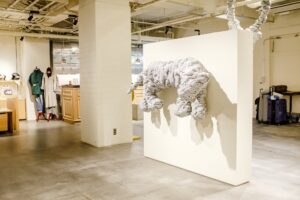
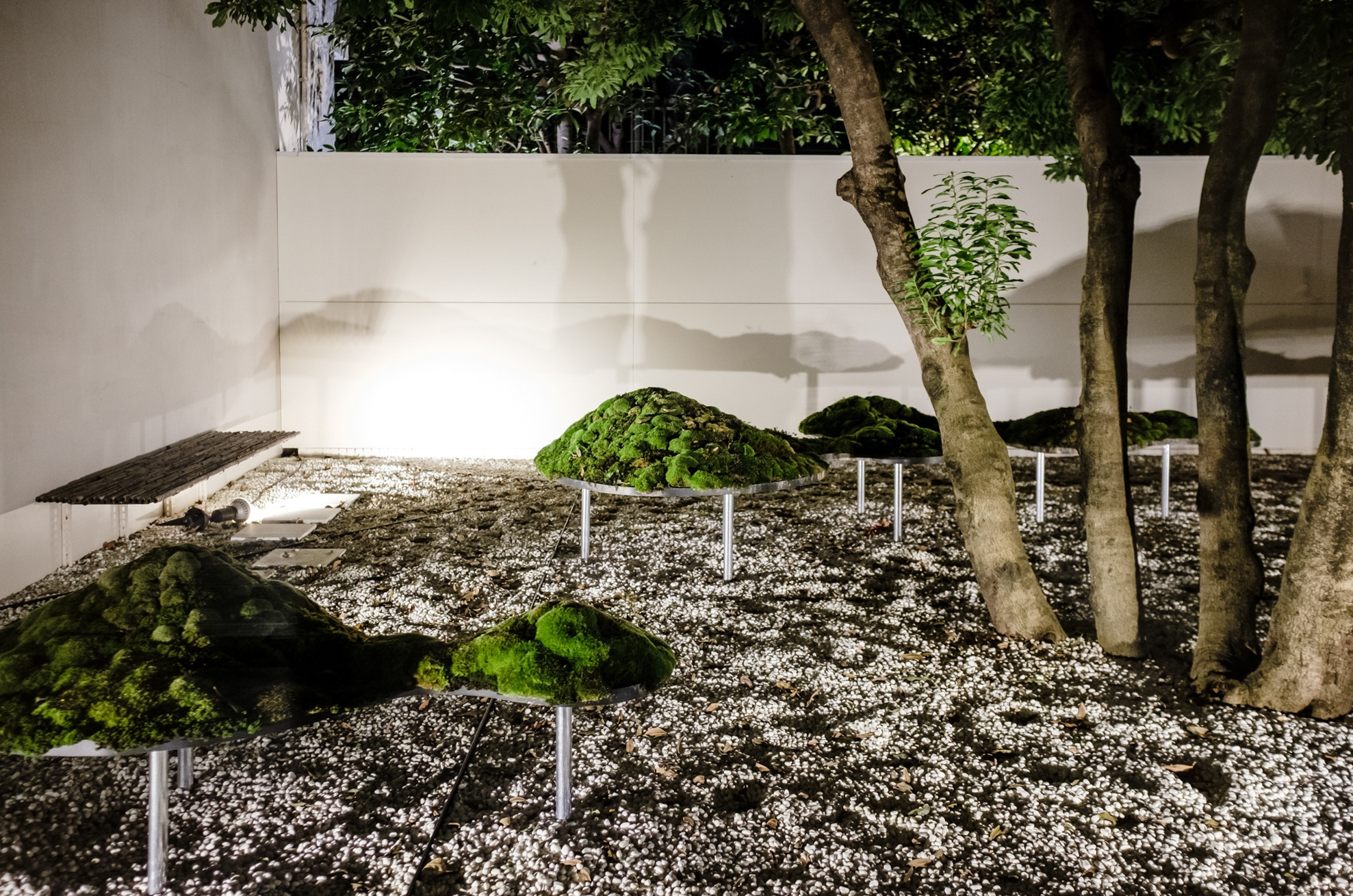
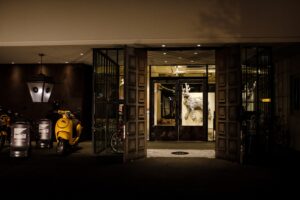
AW: Can you walk us through the concept and execution of Homo Ludens 〜遊ぶ人〜, the exhibition held last autumn at Anteroom (AR)?
SM: I was managing a few things during the development of AR, from its conception to assembling the team and so on. It was like being in a love relationship, where there were lots of aspects that needed to be taken care of. During the first two years after its launch, it was our secret hideout, where I curated shows and organised events. After I left the project, it was like the relationship ended, but I was so glad to see her mature and be able to walk on her own.
“When we were born, we were all free and wild, you age, and then you learn and adapt.” That was the idea AR proposed, and we started talking. They wanted to venture out of the conventional exhibition routine, so I suggested an alternative recipe — an open and free space. Homo Ludens was then set up as the theme, the name of the exhibition was inspired by a book of the same title written by Johan Huizinga.
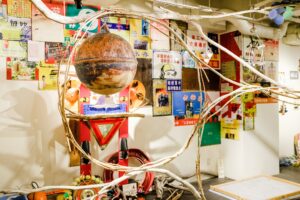
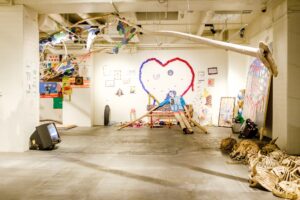
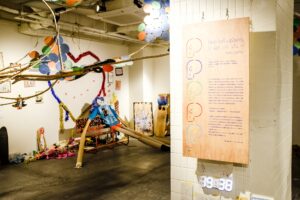
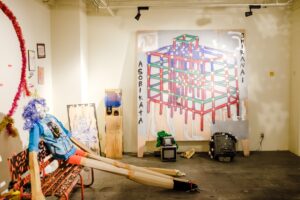
During the opening phase of the project, the team broadly discussed “culture” and how the exhibition should engage with it. But what is culture? You can’t merely fabricate something and just make culture. If you think about it, it’s there before you even notice it. I thought about how we should approach this and decided we could return to the fundamental roots based on our initial idea. What did we do as children? Well, we simply “play”, right? It was a simple enough concept, and basically, we wanted the exhibition to be somewhat like a kindergarten playground, and the exhibitors were like my friends. As you become an adult, you don’t have the opportunity to spend time with friends as often, AR became this promised land where we could do whatever we wanted, as freely as we wanted — we could read, play tag together, roll around in a sandpit, and build something silly out of it. There were zero constraints for both the curator and the exhibitors.
When you think of planning for an exhibition, the structure and organisation are clear, and the expectation and goal are, more often than not, quite clear as well. But this time, I wanted to go the other way. During the exhibition period, you saw artworks appearing on different days, and they were all over this playground. Some were never completed, and I guess visitors were confused. Obviously, it wasn’t familiar to most, we always got questions like, “Is the installation still ongoing?” or “Is this the final form of the exhibition?” My response was, if you recall hanging out with your friends in the park when you were a kid, it never really seemed to end. Whether you played again tomorrow or the day after, the time and place might change, and the friends you played with might also change, but the “play” itself always seemed to last.
Reaching the end of the exhibition period when we had to dismantle, everyone just said, “Let’s play some time again”, and waved goodbye. For me, that was the most satisfying moment of the entire project. So we thought, why not dive deeper and recreate the exhibition in an actual public space in the future? That would be fun.
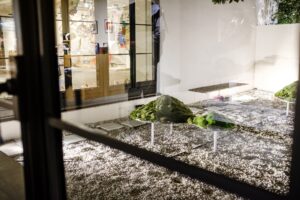
AW: We are witnessing more integrations of artworks and exhibitions in hotels these days. I suppose it’s not only a great marketing strategy but also grants opportunities for creatives working in the industry. How did the exhibition at AR come to fruition? Was it challenging to achieve a balance of your own vision in a conventionally less creative context?
SM: Our benchmark was Ace Hotel, definitely, though its characters seemed to have transcended over time, and so has the role it plays in a city. The bar was set high, but we were determined to match that. I tried not to touch the curation of artworks or the interior design in the Concept Rooms4, as we had some truly talented artists and individuals working on those. It was a situation that I had never experienced before, the unexpected was what made the whole thing come alive.
My part was to coordinate and envision something outside the box. It’s like a gradual expansion process of a universe, you just didn’t know what to expect next. You saw a gallery space pop out in the lobby here, a wall taken down over there; the artworks were like different life forms. As their number multiplied, it was almost as if a kind of symbiosis arose, some of them evolved, and some vanished as this universe kept growing. True that every project requires balance, but when you are creating something completely new, you wouldn’t even know what the right balance is. For me, it was all about making the most exciting choices, and the end result would speak for itself. How to deconstruct and break down any existing balance was possibly the most fun part of any creative process.
AW: Prior to AR and Nue, there’s ovaqe inc., was that the first company you incorporated?
SM: The company was only meant to last for 5 years, that was the plan. After I left 1-10 Design, a few members from the company followed, and that was exactly what I told them: they needed to look for their own clients and gain independence after 5 years. The entire team consisted mainly of creative directors, planners, and producers, without any engineers or designers. Our work ranged from digital commercials to shopping malls and hotel projects, and so on. Whenever a project came along, we assembled a team. Nue operates similarly, the only difference is that the projects we are tackling now are more complicated, with substantially more complex layers.