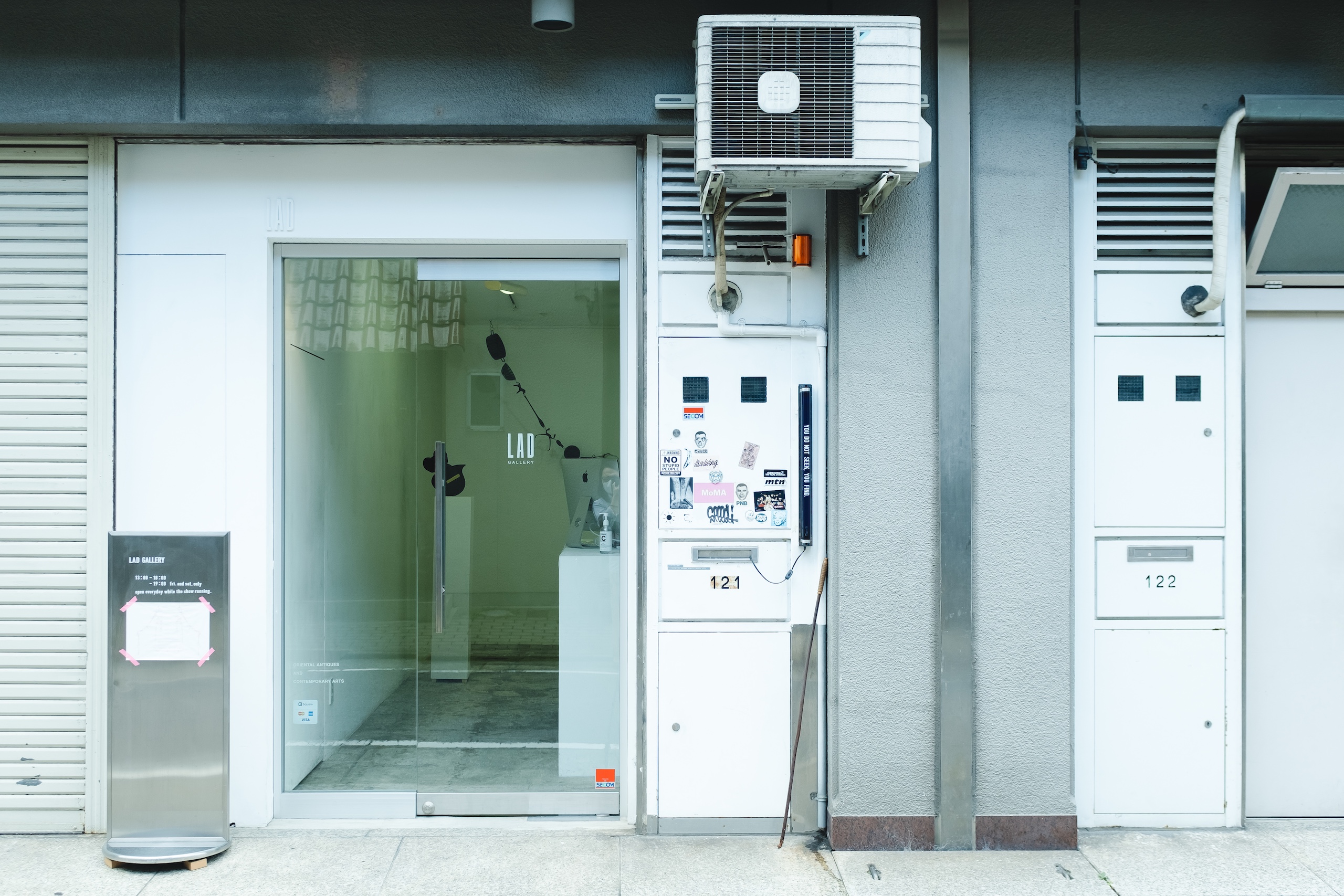
Ryohei Iwata (岩田量平) is a gallery director born and raised in Nagoya (名古屋), Japan. Under the influence of his family and growing up among objects of antiques, Iwata eventually set his sights on the realm of the art world after learning his trade in a gallery that handles mainly classics. LAD Gallery was initiated in 2013, and is located in Nagono (那古野), Nagoya.
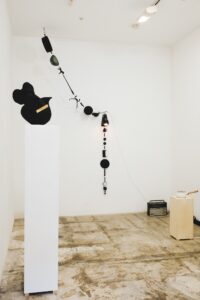
Focusing on emerging artists with a youthful spirit, LAD has exhibited works from the likes of Ei Kaneko (金子英), Genta Kosumi (小澄源太), and more. The gallery is also a regular attendee of various art fairs in Japan, such as ART OSAKA, ART FAIR ASIA FUKUOKA, and artTNZ. We visited Kiyomi+Tetsuhiro Uozumi (魚住紀代美+哲宏)’s exhibition hosted in LAD in July 2020, when the lockdown was lifted in Japan, and spoke with the director about the gallery, his background, and philosophy.
AXEL WANG:
Iwata-san, first of all, what does LAD stand for? In British English, we usually use this word to casually address a boy or a young man, “He’s a nice lad”, “That lad is cool”.
RYOHEI IWATA:
People asked this a lot, and actually, you are not too far off! The “male” aspect was not what we had in mind, however. When we named the gallery, we thought a lot about “youth”, because being young is not always equivalent to the idea of “youth”. It’s more about sensitivity and perception, and that’s how we envisioned the gallery, where our audiences can come and discover works and artists that are full of youthfulness, where boundaries are broken down.

AW: Can you tell us a little bit about yourself? Are you Nagoya-born, and have you always worked in the city?
RI: Yes, I was born and raised in Nagoya. Ever since I was young, I had no problem with being a salaryman (サラリーマン). Immediately after graduation, I got an offer from a bank, and then I was hopping between jobs, a law firm, a university and all, though none of them could be described as my true calling. Both my parents had their own businesses going on, and in order to help in the future, I came to think that I needed to work in a somewhat related environment, and eventually, I landed a job at an actual gallery. It dealt mainly with masterpieces, like Picasso, Chagall, Seison Maeda (前田青邨), and Tatsuo Takayama (高山辰雄). It’s like training and practices, I think it was essential to familiarise myself with the daily operations of a gallery before the big game, learning how to handle clients and sales. After all those years of experience, I realised it’s the expressions of modern-day human beings that interested me the most, so I guess it was natural for me to then step into the world of contemporary art.

AW: You told us the other day when we first met, that your father runs an antique business. Was that the trigger for your interest in contemporary art, and your decision to start an art gallery?
RI: I remember when I was little, we went to Kyoto a lot, because of my father’s work. I used to see a lot of these cool antiques sitting in such modern spaces, and quite a few of them exhibited a curated mixture of contemporary and antique artworks. “Contemporary” is obviously a term that we have in recent decades, all the antiques that we see today, are pretty much contemporary once, and crafted with the latest technology at the time. It’s a bit difficult for me to separate contemporary and antique artworks into different genres, given my own experience, especially growing up with antiques all around me. It’s almost like an affinity that I developed and grew attached to.
AW: For a foreigner living in Nagoya, Nagono is probably one of my favourite spots. I’ve heard from colleagues that this part of town used to be completely run-down back in the day. It’s incredible to see so many vibrant restaurants, shops, and galleries like yours thriving in the area now, not to mention those historical sights too. Why did you choose to open the gallery here?
RI: I wasn’t quite aware of the area in fact, it was only a few years ago that my family happened to move into an old house in Nagono, and I saw this abandoned warehouse, then decided to rent it and start LAD. And yes, I think you are quite right, the area has so much potential, it’s close to Nagoya station, which is the heart of the city, and yet you are still able to experience a rather typical and local Japanese atmosphere here. Not only restaurants but also independent theatres are opening up, and lately we’ve even had a bouldering gym!
AW: Locating the right artists to work with is not always easy. Can you walk us through your process? How do you normally unearth talented artists? Do you have to attend art fairs or biennales on a regular basis?
RI: I used to go to graduation shows a lot, recently it’s all social networking. Not only because of the pandemic, but SNS has become an inseparable part of everyday life for many youngsters. We are living in an era where almost everyone has their own homepage or social network account. Especially during graduation seasons, we come across all sorts of interesting works posted on SNS from students.
I used to jump around and judge the artworks I saw with my bare eyes, these days I’d like to get to know the artist as a person. As layers of barriers are removed, you get to speak with individual artists directly, not only experiencing their works, but also hearing what they have to say is crucial for me. It’s never really about the artists’ manners or whether they bow, but their urge and desire. You sense their passion to create, what they would like to express and tell the world, that’s something I value as a gallery director. Where you graduate from, what your major is, those are never really my concerns either. You don’t have to graduate from art schools to be an artist, probably half the artists that we have presented are not formally trained art students.

AW: COVID-19 has been on everyone’s lips for the past 6 months. Has it affected your work at all?
RI: We had to close the gallery due to the lockdown, right after the ART NAGOYA fair that was held at Hotel Nagoya, which we participated in back in February. We weren’t able to see as many works as we did before, but at the same time, I felt that there were new angles and possibilities. Right now, we are in talks with a company that handles online sales of artworks.
AW: Please forgive us for prying into your Instagram, we found that you are also quite the musician. If not a gallery director, would Iwata-san have taken a different career path, perhaps as a music performer?
RI: I’ve always been passionate about music. I wouldn’t say I’m particularly good at any instruments, I just enjoy playing! If I were born again, yes, maybe I would like to become a musician, though, weirdly enough, I prefer to keep my feet on the ground, even when I was a child, I was quite realistic. I guess that was probably the reason why I thought it wasn’t so bad being a salaryman! (Laughs)