
14 December 2019
When I visited the exhibition in November 2019, I had no idea who Daniel Arsham was. True, that probably only highlighted nothing but my own ignorance, but in my defence, my justification would be that the world is too big and there are too many names, so what can I say.
But hold on.
The second I stepped into the exhibition hall, without even flipping open the exhibition leaflet, there was that “ah-ha” moment. Turns out I wasn’t all that ignorant after all. Of course I had seen his works before, it simply never bothered me enough to look up the name, hence no correlation was drawn.
You know sometimes when you see something every now and then, so often that, you kind of just want it out of your face, Frida Kahlo, or the Kardashians, for instance. But I suppose when the fame of a certain individual reaches somewhere bordering on pandemic level, there is no escape, whether you want it or not.
So there I was.
Back in a time when we were still safe and free to hop on any flight without worrying about certificates, documents, health declarations and all, straight after landing in Shanghai from Nagoya (名古屋), I found myself setting foot in HOW Art Museum (昊美术馆) for the very first time.
Opened in 2017, the museum sits on the outer skirt of the city, east of Pudong1, away from much of the hustle and bustle. The area itself was largely industrial only a decade earlier, but with the backing of a centralised government, paired that up with the arrival of Disneyland, things began to change. “Emerging” would probably be the right word to describe it.
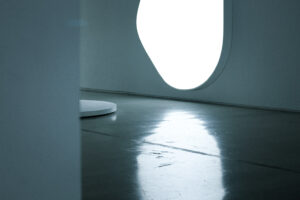

Emerging it is.
A word that has been synonymous with both China and Shanghai for quite some time now, although some may consider that the latter has long since “emerged” already. Both have undergone dramatic and drastic transformations, not only in terms of urban development and infrastructure, but more significantly, in the mindset of the people.
Perhaps driven by wealth, perhaps by social media frenzy, as more and more of them climb up the social ladder entering a newly formed bourgeois state, armed with international outlooks and growing cultural awareness, the art and design sector, has gone only one way. The undisputed bull’s-eye of the country’s art arena, has experienced tremendous growth in both demand and supply, so remarkable that, while comparable developments can be observed elsewhere in the world, few have matched the scale, speed, and intensity.
Entering HOW.
What could possibly be better than yet another contemporary art museum stuffed with international huge-name artists and designed to engage a young, selfie-hungry horde? Owned by an art-loving real-estate tycoon, the institution’s vision is, and I quote: “HOW is a place in which art and space interact quite naturally… It’s about developing a lifestyle and hosting exhibitions that connect to young people.”
Fair enough.
Sat next to a supposedly luxury hotel, boasting a MoMA2-inspired gift shop selling artists’ merchandise and a never-can-go-wrong trendy café, the whole setup embodies such a particular lifestyle that any young kid could aspire to — it’s not about experiencing art, it’s about the whole package.
It’s curious, however, when you read a statement like that, it makes you wonder whether those faceless executives or half of the internet in fact, suffer from paedophilia-alike syndrome. I’ve personally never really quite understood the marketers’ forever old obsession with chasing after the “young people” like they are some dragons and phoenixes.
Why not appeal to your mother or grandfather? What exactly is wrong with someone old-er? They have the time, they have the means, and I’m sure as hell most of them are still eager to learn. Being old is not equivalent to becoming oblivious, or dead, right?
Is it because most of them are wise enough not to fuck around on social media and therefore no free ads for the brands and whatnot, I can’t tell, but it’s always the young, the millennial, the Gen-Z and the alphas that these people must appeal to, how has this not been killed in the boardroom already.

Anyway, Perpetual Present, that is the name.
Whether this is an exhibition title drafted up by the marketing department or the artist’s studio, it is full of ingenuity. It’s so precise, in just two words, it wraps up Arsham’s aesthetic language and conceptual ideal, creating an epitome so alluring and poetic, yet perfectly apt, for the age of social media.
As for the exhibition itself, you would come across familiar terms and phrases such as, ahem, “ambiguity crystallisation”, “blurring the boundaries between present and future”, “interactive artworks that engage audiences”, and my personal favourite, “disrupting the linearity of time”. Seriously, by now, if you are still scratching your head over these seemingly inscrutable and indecipherable words, usually found on museum and gallery walls, honestly, you are fine, even if you are not some modern-day cultural globetrotting warrior. The problem with this art-speak language, as it appears in artist and exhibition statements over and over again, is not the vocabulary itself. Rather, when writers substitute these words for something precise, the words lose almost all their weight and bearings and become practically meaningless.

But let’s come back to the exhibition.
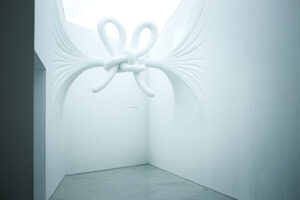
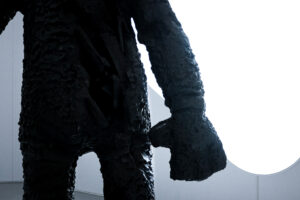
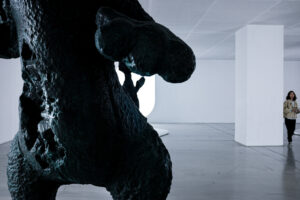
Meet Arsham’s most iconic works, all stamped with his symbolic, signature language of decay and temporal confusion. You move past gigantic bronze pop-art sculptures one after another, enter a somewhat futuristic excavation site littered with objects unquestionably belonging to the present day, and of course, you would also encounter the large plaster knot bridging two facing walls, which has probably shown up in your Instagram feed a thousand times, so often that seeing it in person might strangely feel like scrolling past it again.
There goes the whole shebang.
And what’s more, you could even get a taste of his celebrity status — a quick glance at Arsham’s long list of prominent collaborators, including Pharrell Williams and Dior, and you will sort of think, the guy has pretty much made it.
Not only has he exhibited similar works all over the world, without having reached the age of 40, if I may also add, but when this solo exhibition greeted the beloved art-loving crowd in Shanghai, at a neatly designed, 3-story contemporary art museum, concurrently, a Joseph Beuys3 exhibition was taking place on the floor above (which I’m sure the Beuys representative okayed it). For me, that carries enormous weight. Being named one of the world’s Top 100 Influencers by Hypebeast4, on the other hand, carries marginally less, it remains a powerful signifier nonetheless.
This romantic image of the poor and starving artist, surviving on dirt while living in a shithole without a roof, is no more. They are the rock stars of our contemporary culture, selling blockbuster tickets for museums and galleries. They are the KOLs with millions of followers on whatever social media platforms. They are cultural supernovas who transcend the boundaries of the art world.
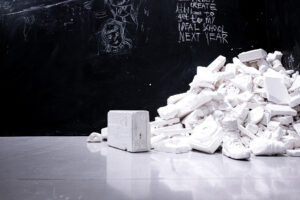
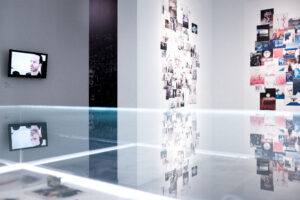

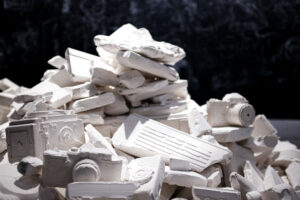
Then you have the collaborations.
When you see Arsham’s cringe-worthy “collab” with Pokémon (apparently IKEA is next), your eyes are probably rolling into the back of your head already, and you don’t even need to be that cynical. Honestly, it is hard not to feel ambivalent, even lethargic, and at times, it feels as if the artist has been whoring out his own name one way or another, regardless of whatever motives may lie behind all these sham marriages. It’s evident that he’s more concerned with cashing in, than selling out, and, to be fair, there’s nothing wrong with that.
Arsham has deftly constructed a visual identity so strong that this cult-like following surrounding his work almost feels well-earned. As a spectator, this is not to stand on moral high ground preaching that artists should never mingle in the game of money play, that they should always be burdened with social responsibility before quietly dying in a ditch. At a time when every marketer seems desperate to court the young, I simply wish someone like him could stray from the path that lowers himself to becoming another Supreme. In a cultural landscape already so saturated with commercial cacophony, perhaps the guy could challenge himself slightly further and conjure up something a little bit stranger, a little riskier and more magical for the kids.
As Jian DeLeon5 once said, “We have to feed the kids fruits and vegetables; it’s not hard feeding them junk food.” An eroded Pokémon (or IKEA for that matter)? Surely, we can do better than that.