
I remember coming across the name Hiroki Osuka for the first time. It was an odd moment when I received an email response from Ziggy Chen¹, the Shanghai-based fashion label, regarding some trivial matters. It was hard to miss the sign-off, because it wasn’t exactly common to find a Japanese individual working for a relatively niche Chinese fashion designer. That was in 2018.
Ever since, I have kept an eye on Osuka’s work, especially after relocating to Japan myself. At some point, I discovered that he was now based in Nagoya. Without thinking twice, I reached out to the man, hoping for a chance to speak. Looking back through my inbox, the invitation email I initially sent out was in May 2022. I’m sure this is relatable to many — it’s like writing a fan letter. After pressing the “send” button, you are left in limbo, experiencing silent moments of uncertainty and agitation. Those moments may well stretch into days or even weeks, even though by now you have learnt to cope with expectation management and are equipped with an armour so thick that no rejection can penetrate. But still, those awkward seconds, or perhaps minutes, that one has to endure upon being turned down — I mean, no one genuinely enjoys a bitter disappointment, right? Besides, Osuka’s personal website is nothing short of spectral. “Is there even a person behind this enigmatic façade?” I found myself wondering.
Fortunately for me, none of the above was the case here. Osuka responded swiftly and sincerely to my invitation and agreed to an interview, very much to my delight. Albeit seemingly inscrutable when we first met, over the course of the following seven months, Osuka welcomed me to his studio with open arms, offering a glimpse into some of his very own recent textile developments. We shared coffees and meals together afterwards, and I listened to his stories and about the days he spent in Shanghai. Savvy as he was, Osuka’s eyes would light up at the slightest mention of textiles, if uninterrupted, he could probably speak on the subject for quite some time.
Even though Osuka and I have only met a handful of times, I felt as though I had known the man forever. This is not something one can say often, especially as one gets older. Perhaps it’s because we share a similar background in textiles and a mild interest in fashion, or perhaps simply because we speak the same languages. And isn’t that just one of the most beautiful things — human connection? In the post-COVID days, I don’t know about anyone else, but I personally longed for human connection once more. Without even realising it, I had missed those days when you could just speak to a real human being without wearing an ugly mask, when you no longer had to sit in front of a bloody screen conducting endless Zoom calls, watching all your energy drain into a bloody black hole, let alone dealing with all the inevitable technical issues. It’s good to have some humans back, I guess.
Please find the first chapter of our conversation below. In this chapter, we spoke about the things that Osuka actually does — textiles, while he also shed light on his motivation for moving from Toyohashi (豊橋) to Shanghai, China, nearly 20 years ago.
A Stranger in Shanghai

AXEL WANG:
How would you describe the job that you’re doing now Osuka-san? Because you don’t just produce textiles.
HIROKI OSUKA:
That’s a tough question… Everything that I do is connected — I source textiles, I develop and produce textiles, I work with textile manufacturers to create new fabrics, and I work with labels to help with their collection development, also in terms of the commercial and marketing side, since I have a background in wholesale. Therefore, it’s not only about consulting on the fabrics, but more about the whole brand — how to differentiate, what the right price point is, who the right audience is, and so on. When I talk with the buyers, that provides me with ideas for fabric, and when I work with a textile manufacturer, I have to take the market into consideration. So, it’s quite hard for me to narrow it down to just one word to describe my occupation.
“…textiles are so fundamentally connected with people’s way of life and their beliefs,
and that’s what fascinates me.”


AW: In Japan, where the culture of business cards remains so relevant, what does it say on yours?
HO: It doesn’t say anything. (laughs) Just a name and an address.
AW: Same here, I can imagine it being a little bit confusing for people.
HO: Yes, very much so. Usually, I then explain to people what I do, most of the time, they want a straight answer: “Oh, so you are like a textile producer.” Technically, it’s not wrong, textiles have really been my biggest passion, and over the years it has grown to become a core part of who I am, even outside of work, I’m always thinking about textile — researching traditional techniques, hunting for vintage fabric, or visiting craftsmen. My lifestyle, my work, and everything else that I do are kind of all intertwined.
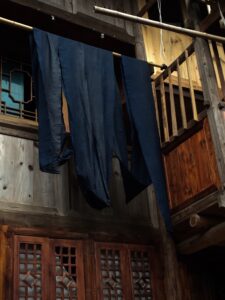
After engaging with this subject for so long, like, I see the world differently, I’m able to understand different cultures through textiles. When I was showing you those old vintage fabrics from Miao (苗族)2, for example, I came to understand their lifestyle after visiting them in Guizhou (贵州), why they make fabric, why it’s dyed a certain way, and why the patterns — the geometrical patterns that you saw — exist. There are always meanings underneath.
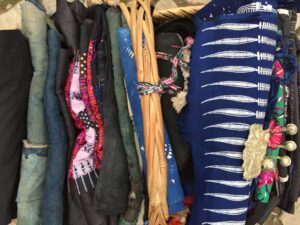
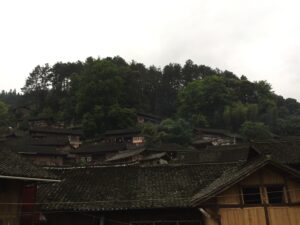
Whether it’s from Peru, Mexico, India, or Japan, textiles are so fundamentally connected with people’s way of life and their beliefs, and that’s what fascinates me. I mean, nowadays, textiles probably have a different meaning, it’s much more diluted and tapered, it becomes more about the clothes that you are wearing. But as you dive deeper, zooming in closer, especially with the vintage or historical fabrics, you start to gain an incredibly profound understanding of the actual people and their cultures. For me, the word “textile” already has like multiple dimensions. It’s not just a job or a piece of cloth, it’s culture.
AW: Let’s travel back in time for a bit before we go further. For those who don’t know you personally, you went off to Shanghai at the age of 16. Why Shanghai?
HO: Back then, the idea of going to Shanghai came to me like, it really was a mere coincidence. Growing up in a small city in Aichi Prefecture in Japan, I always wanted to see what’s out there. You watched television and movies and stuff, so you knew, like, there’s something going on in the world, outside of this little place where I lived.
I think I told my parents that I, umm, wanted to go somewhere, you know? Obviously, I knew of America, the likes of the UK or Canada. Those were the names that would pop into anyone’s mind first, right, if you were to study abroad. Then somehow, I saw this ad when I was 14 or 15, in a shitty magazine, and it said, “Study Abroad in Shanghai.” That was shocking, if I’m honest, almost eye-opening. I mean, I had never thought about the prospect of studying abroad in China. The idea just hit me, and I thought, that’s like the most interesting thing to do.
AW: But you didn’t speak any Chinese?
HO: Nothing. I studied English in elementary school and junior high, but Chinese, no. I mean, China was such a mysterious, unknown country at the time, except for all the Kung-fu movies, but that’s about it. I knew nothing about Shanghai either. I didn’t know the language, but that was really, really enthralling for me, like going somewhere that I didn’t know anything about. I think I’ve always been a curious person, and I always wanted to do something different, so that’s that.

AW: You saw an ad and then you were off. That’s incredible. We’re talking almost 20 years ago, back then, China was not what it is today. You didn’t speak the language and it’s a completely different culture, how did you feel? A young boy at that age, it must have been fucking terrifying!
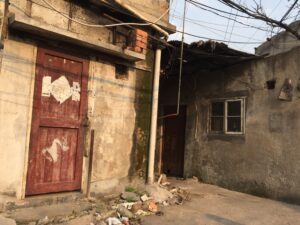
HO: Exactly! (laughs) No, I loved it. Everything in Shanghai stood in stark contrast to Japan. Japan is just so organised, set in stone even. Things in my hometown haven’t changed one bit since I left. It’s probably been like that for the past 30 or 40 years. I’m not saying it’s dead, but it’s not very much alive either. China, on the other hand, especially Shanghai, was changing by the minute.
Of course, it wasn’t easy. It took me a couple of years to adjust physically, adapting to the food, the climate, everything. And you were right, many things were absolutely appalling to me in the beginning, but I genuinely loved the whole vibe, being in a different environment and having to learn something new every day. It was joyous, really. There was this sense of freedom back then in Shanghai, solely because it was still under construction. I’m not referring to the buildings alone, it’s the whole culture, the whole society. There was this feeling that anyone could be who they wanted to be. If you had an idea and had the guts, you could do it. You don’t really get that in Japan — where you must stay grounded and work your way up, step by step. I guess it really was this kind of sense of freedom that kept me there for the next ten years.

AW: When did you start working with Ziggy Chen?
HO: It was before university graduation actually, while I was taking a fashion marketing course.
AW: So you went from English literature to fashion marketing?
HO: Yes, I only did that for about half a year. Funny enough, it was mostly Shakespeare, and the whole thing just drifted away from reality and became so unreal to me. It wasn’t that I didn’t appreciate literature, but it wasn’t like I was heading for the theatre, you know? So I soon switched courses. After a few years of studying, obviously, at that stage you start wondering about your future, like which brand you wanted to work for, whether you should stay or go back to Japan, and so on. I think it was around 2010, right when I saw this capsule collection presented by Ziggy in Xintiandi, Shanghai. It was called Decoster Concept then, and it just blew my mind because it was completely different from everything I knew about Chinese fashion, or fashion in general, even. It was probably on that very same day that I sent them an email asking for a job. (laughs)

AW: What were your roles at Ziggy’s?
HO: I started as an intern doing visual merchandising. Sooner or later, I was kind of promoted to become, like, a brand manager. I don’t know, Ziggy probably saw something in me, I guess. (laughs) And that’s when I started to manage the sales and wholesale side of the business. After a while, we just naturally began working together on collection development. We travelled around Europe sourcing and developing fabrics, going to places like Italy or India for inspiration, and that’s practically how I got into fabric development in the first place. At the time, I wholeheartedly believed in what we were doing, and I saw it as some kind of mission. I was very devoted to this cause, you know, like, I felt like this was something that I must do! I remember thinking, I found this amazing designer in China, and I wanted to tell everybody about it!

AW: From where I stand, I sometimes feel that there’s this almost polarised view of China as a nation, that the West and some others are, in one way or another, offended perhaps by how the country is rising up, it’s often being portrayed as this devilish opponent in the media. As a Japanese national who speaks Chinese fluently, lived and worked in China, and is very much immersed in the society, how do you see this country yourself?
HO: I guess it’s understandable that in the West or in Japan, like people sometimes have this antagonistic view of China, seeing all the negative stuff from the mainstream media. But I do think it’s vitally important that we don’t mix up the government and the people. If you go to China and actually meet the people and spend time with them, in no time you would see that many of them are extremely intelligent, very polite. This is something that Ziggy taught me too. Well, he didn’t actually lecture me or anything, it was only by spending time with him, seeing the kind of person he is. Ziggy is poised, polite, has a very open mind, and it’s incredible to see how much faith and trust he places in the younger generation. Over the years, we formed a very special bond of friendship and a professional working relationship. I don’t mean to draw comparisons with Japan again, but it’s not something that I come across very often here, if I’m honest. I guess it’s thanks to knowing people like Ziggy that I slowly, gradually, began to realise that, maybe what I saw in the media, or what I used to think, or what people said, wasn’t entirely true. It wasn’t the whole picture, at least.