30 May 2020
We would like to present a series of photographs documenting Nariwa Museum (成羽美術館), located in the rural area of Bitchū-Takahashi in Okayama Prefecture, known not only for its vast mountainous landscape and ancient castles, but also for its impressive collection of art museums scattered throughout the prefecture.
Completed in 1994, the Nariwa Museum was constructed in honour of the locally born artist Kojima Torajirō1. After a 90-minute journey in the rain departing from Okayama Station, the first thing that struck me upon arriving on site was the peculiarity of its location — I failed to conjure up a better phrase to describe it — literally in the middle of nowhere, there it was. But don’t let the initial cynicism get hold of you so quickly, I thought, and I was right. One may only be able to fathom why once you open up and embrace the museum together with its surroundings.
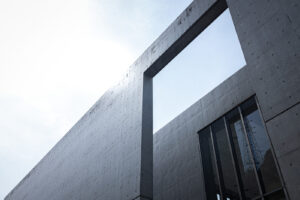
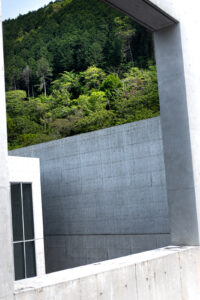
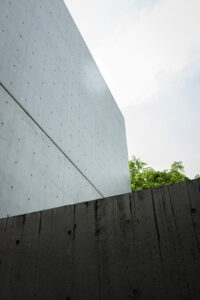
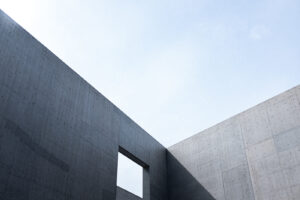
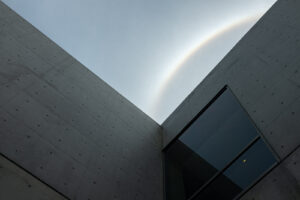
Walking up a set of stairs upon arrival, the towering unadorned concrete walls of the museum, amplified by the grandiose glass windows, their physical presence would hit you instantly. The sky started to clear up as if the piercing lines of the building’s exterior façade had sliced through the clouds. The architecture is here stating its existence, as though announcing to the visitors who have come a long way that they have come to the right place. It stands tall and firm before everyone, acting as a reminder that this is, in fact, also an area of historical significance and archaeological interest.
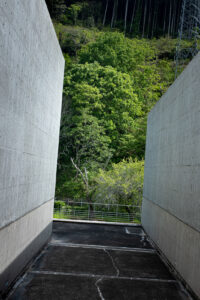
Make no mistake, this is distinctively Tadao Ando2, the industry’s colossal titan, who had probably shaped my earliest impression of modern Japanese architecture — the minimal, the grey, and the sharp edges. However, Ando’s works are never about taking over, on the very contrary, another penetrating theme constantly recurring throughout the master’s works, is the unmasking of the environment enveloping the architecture.
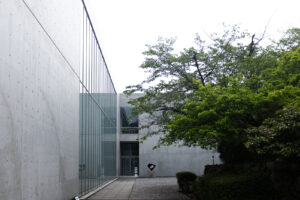
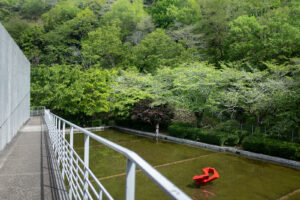
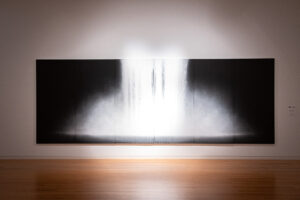
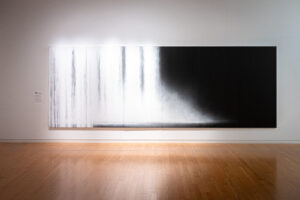
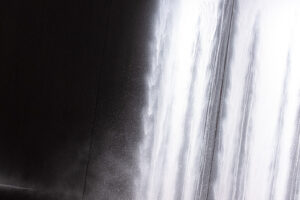
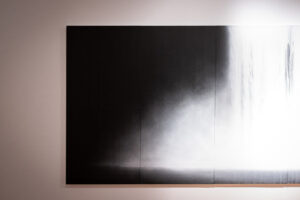
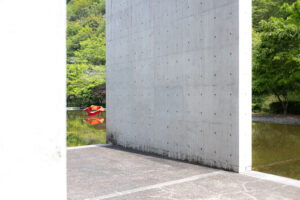
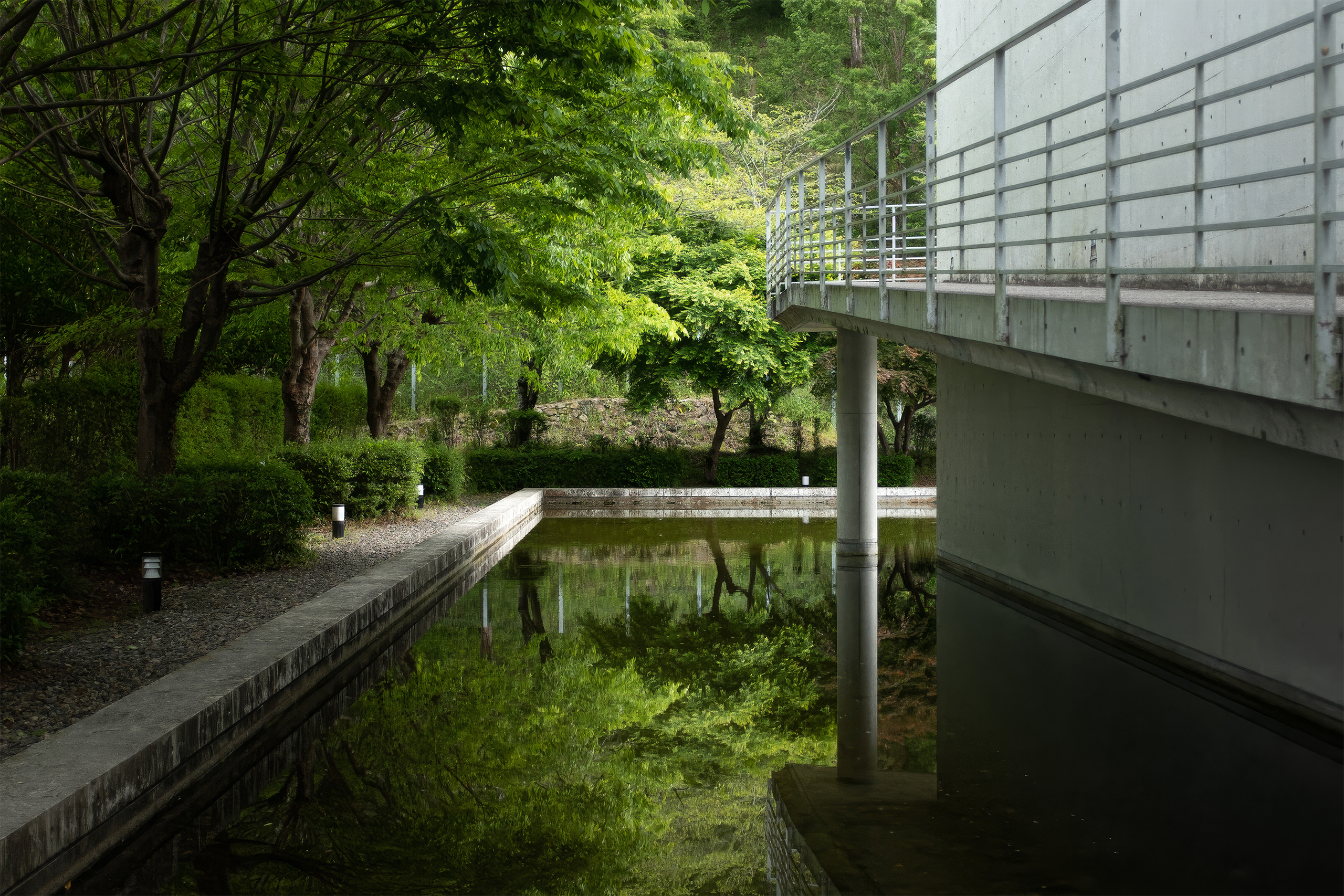
Whilst at first your gaze would unquestionably gravitate towards the subject in question, as you roam around and listen to this geometric poetry sung by the architecture, shrouded in and elaborated by nature, you begin to see that the building’s hard edges are relieved by the tranquil waters and the verdant, forested mountains. The soft grey of the concrete captures the spring greenery beautifully like a moving painting stirred by the wind. No wonder Hiroshi Senju3, an abstract expressionist and Nihonga (Japanese-style painting) master known for his minimalistic approach and ancient Japanese painting techniques, chose this particular venue to exhibit his works.
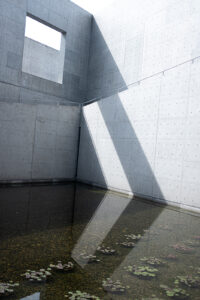
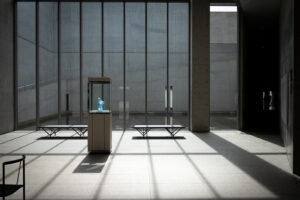
Once out of the exhibition hall on either floor, you are greeted by an open space encircled by a transitional concrete slope, where the shadows and natural light dance gently upon the still reflection of the water garden — a perfect epitome of the entire museum, I felt.
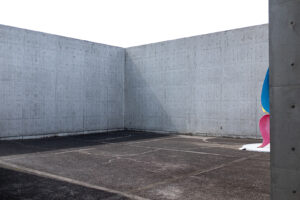
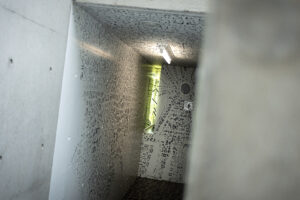
Situated just a few feet away from the main building, a museum’s public bathroom may, in general, sometimes be neglected by visitors or even the architect, but this was surely not the case at Nariwa. A reprise of the collaboration between Ando and the artist Shuji Mukai (向井修二), in which the latter painted the entire bathroom with his signature “symbols”, reminded me of a book by Jun’ichirō Tanizaki called In Praise of Shadows, which I read during my university years. Not because of the art, but because of its discussion of a traditional Japanese toilet, which Tanizaki described as “a place truly of spiritual repose”.
The bathroom at Nariwa is most definitely not a traditional one that sits within an impeccable Kyoto temple, but certain parallels can be drawn. It might be strange to call a public toilet “elegant”, but the aesthetic it carries is in perfect harmony with the museum’s architecture. Being partially open, with the rustling leaves and birdsong accompanying you, the experience of going to a public toilet is, apparently, no longer a dreadful one.
Standing before the running water garden outside, partly enfolding the museum, staring at its crystal-clear reflection, it felt as though mist and fairies would emerge from the rain-soaked soil and the grove of trees. The journey into the middle of nowhere became an escape from the sterility of life during the pandemic and its endless chambers of information, rewarded by the chance to witness this concrete magic.